
Common Problems
Water in the Bottom of the Dishwasher: Four Places to Look, Cheapest First
Work through four places in this order, because it goes from free to a plumbing bill. First the filter in the floor of the tub, which unscrews by hand and is the answer most of the time. Second the drain hose behind or under the machine, which kinks where a cabinet was closed on it and blocks where it loops. Third the air gap on the counter if the installation has one, a small chrome cylinder beside the faucet that unclips and clears with a finger. Fourth, and this is the one worth knowing, the knockout plug in the garbage disposal. A new disposal ships with a solid plug in its dishwasher inlet, and if the installer never punched it out, the dishwasher has been draining into a closed pipe since the day it was fitted. That is the explanation for a machine that has never drained properly rather than one that stopped, and it is a plumbing job rather than an appliance one. Bail the standing water out with a cup and a sponge before you start.
The full guide
Why is my Whirlpool dishwasher not draining: work from free to expensive
There are four places the water can stop, and they cost very different amounts to deal with. Taking them in order is worth more than knowing anything about dishwashers, because the first is free and it is usually the answer.
Before anything else, bail it out. A cup gets most of it, a sponge and a bowl get the rest, and ten unpleasant minutes makes everything below possible.
One: the filter, and what normal looks like
A small amount of water in the recess under the filter is meant to be there, keeping the pump seal wet. Water lying across the flat floor of the tub is not.
Pull the bottom rack out. In the floor of the tub there is a cylindrical filter that twists counterclockwise and lifts out, and a flat screen underneath that lifts away once the cylinder is gone. Rinse both under a running tap with a soft brush, nothing stiff enough to distort the mesh.
Then look into the recess they came out of. This is the step people skip. A shard of glass, a fruit sticker, an olive pit or a folded piece of foil over the pump inlet blocks the drain as well as a packed filter does, and it is invisible until the filter is out.
If the filter came out clogged, run the machine empty on a normal cycle before deciding anything else.
Two: the hose
The drain hose leaves the machine, goes under the sink, and ends at the disposal or the standpipe. Two things go wrong with it.
A kink. A dishwasher gets pulled out for a floor, a leak or a cabinet job and pushed back with the hose folded against the wall. This is the most common installation-related answer.
The high loop. The hose is supposed to rise close to the underside of the counter before dropping to the drain connection. That loop stops sink water running back into the dishwasher. A hose lying flat along the cabinet floor gives a machine that fills whenever the sink drains, which people report as "it will not drain" because the outcome looks the same.
Three: the air gap, if you have one
Not every South Florida kitchen has one. If yours does, it is a small chrome cylinder on the counter beside the faucet, and it is the most neglected part in the kitchen.
The cap lifts straight off and the plastic cover under it twists out. What is inside is usually a plug of the same material that was in the filter, and it comes away with a finger and a rinse. Five minutes, no tools.
A blocked air gap backs water up into the dishwasher, and often shows itself first as water spitting out of the chrome cylinder onto the counter mid-cycle.
Four: the knockout plug, and the machine that never worked
This is worth reading even if your machine used to drain fine, because it explains a category of complaint nobody ever solves.
A new garbage disposal comes out of the box with a solid plug molded into its dishwasher inlet, so it can be installed on a sink that has no dishwasher. Fitting one on a sink that does have a dishwasher means punching that plug out and taking it out of the chamber.
If that was never done, the dishwasher has been draining into a sealed pipe since the day the disposal was installed. The symptom is a machine that has never drained properly, and it is common after a kitchen refresh or a landlord's disposal replacement.
The related version is the plug punched out and left rattling around inside the disposal chamber, where it works its way back into the outlet.
Either way this is a plumbing job rather than an appliance one, and it is worth knowing before an appliance visit is booked. Nothing about the dishwasher is wrong.
What the machine may be telling you
Whirlpool publishes error codes for its dishwashers, and also the older way of showing the same information, as counted groups of blinks separated by pauses. One of the maker's own pages says explicitly that a particular blink pattern and a particular F-code are the same message.
Worth knowing: the four places above are not our invention. Whirlpool's own page for the dishwasher code F9E1 asks, in order, whether the filter has been removed and cleaned, whether the drain hose is kinked, pinched or clogged, whether the sink disposer is clear and its knockout plug was removed, and whether there is an air gap. Same four, same order.
Write down what you see exactly, including how many flashes come before each pause, and read the code before ordering anything against it. These machines have codes about water arriving as well as water leaving, and they are not the same repair.
One more from the maker's own documentation, because it saves calls: on machines with a colored status light on the front, a blinking light means the cycle has paused. Not failed. Close the door firmly and press start.
If it turns out to be a repair
What this leads to, and what it costs
Every job on this site is priced the same way: an on-site diagnostic first, the figure agreed in writing before anybody starts.
-
Water standing in the bottom when the cycle ends Dishwasher will not drain
Whirlpool's own label for this is Long Drain, and the machine reports it as F9 E1 — or, on a dishwasher with no display, as nine flashes of the Clean light, a pause, then one flash. Learning to read those two bursts turns a blinking light into the same information a display would have given you.
- F9 E1 and nine-pause-one are the same report on two generations of the same machine
- Water in the filter recess at the end of a cycle is normal; water covering the floor of the tub is not
- The air gap or the disposer connection is outside the dishwasher and causes this constantly
-
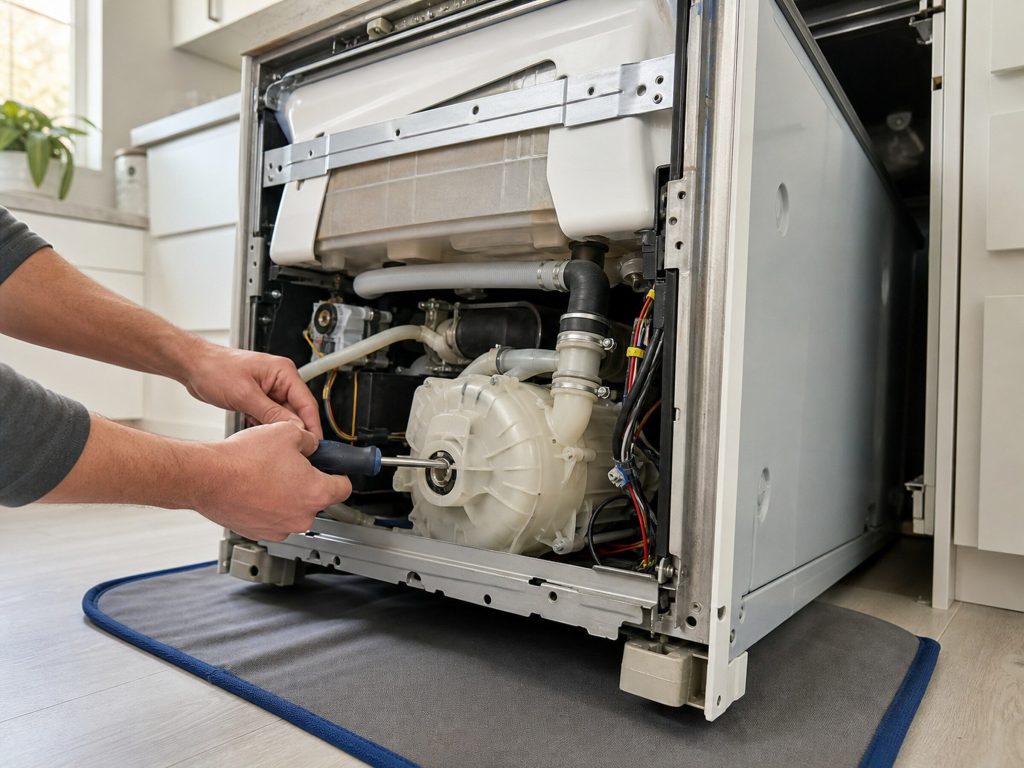
from $135 Dishwasher drain and pump repair
Water standing in the bottom at the end of a cycle is the most common dishwasher call there is, and on a Whirlpool it is worth taking in order because most of it is not the pump. Filter, hose, air gap and the disposal spigot come first, and this make publishes flashing-light sequences and F#E# codes on the drain circuit that tell you when to stop looking at the plumbing and start looking at the machine.
- Filter, hose and disposal spigot before anything is opened
- This make reports drain issues both as F codes and as counted flashing lights
- A drain pump is a contained repair; a knocked-out disposal plug is a five-minute one
-
from $119 Dishwasher wash performance service
Dishes coming out dirty or filmed is the complaint with the widest range of causes and the smallest average repair. Spray arms, filter, water temperature, detergent, hardness and loading account for most of it, and Whirlpool devotes 27 pages of its own base to wash performance for exactly that reason. It is diagnosed as a system, not as a part.
- Twenty-seven pages of this make's own base are about wash results, and they are not all the machine
- Hard water here leaves film that reads exactly like a broken dishwasher
- Priced on time, and it frequently ends with no part at all
Questions people ask about this
There is always a little water in the bottom. Is that wrong?
A small amount in the recess under the filter is normal and deliberate. It keeps the pump seal from drying out. Water standing above the filter, over the flat floor of the tub, or deep enough to reach the bottom rack, is not normal and is what this page is about.
The lights are blinking. Does that mean it is broken?
Not necessarily, and Whirlpool's own documentation is clear about one case. On machines with front status lights, the maker publishes blue for washing, red for drying, white for cycle complete, and blinking for a cycle that has paused. A paused cycle with water in it is a machine waiting rather than a machine failing. Close the door firmly and press start again before assuming anything.
Should I run the disposal before the dishwasher?
Yes, and it is the cheapest habit on this page. The dishwasher drains into the disposal on most kitchen installations here, and food sitting in the disposal chamber is a partial blockage the dishwasher has to push through. Run it empty for a few seconds before starting a load.
It shows a code. Does that tell me which of the four it is?
Sometimes, and it is worth reading rather than guessing. Whirlpool publishes a set of F-codes for its dishwashers and also publishes the older blink patterns that mean the same thing, counted as groups of flashes with pauses between them. Note the code exactly as it appears, including whether there is a space in it, and look it up before ordering a part against it.
Common Problems
More guides like this one
-
A Washer That Walks: Telling the Load Apart From the Floor
Two different problems arrive as the same sentence. A five-minute test with three towels separates them, and the answer often turns out to be the floor rather than the machine.
Read more -
A Washer Stopped Full of Water: Top-Load and Front-Load Are Not the Same Job
A Whirlpool washer not draining water is two different machines with two different answers: a front-loader has a pump filter the maker tells you to clean, and a top-loader does not.
Read more -

A Whirlpool Washer That Sits on Sensing, and What It Is Actually Doing
Sensing is not a pause before the wash. It is a measurement, and a machine that will not leave it is reporting that one of the three things it measures did not come back.
Read more
Tell us the model number and what it is doing.
This article is based on:
- Official manufacturer documentation
- Internal repair procedures
- Technician repair history
- Company quality standards