- “Whirlpool publishes separate pages for too hot and too cold, calibrated and not yet calibrated”
- “A consistent error is adjustable; an inconsistent one is a sensor or a control”
- “An oven thermometer costs very little and settles the argument before anybody is called”
Symptom
Whirlpool oven runs hot or cold
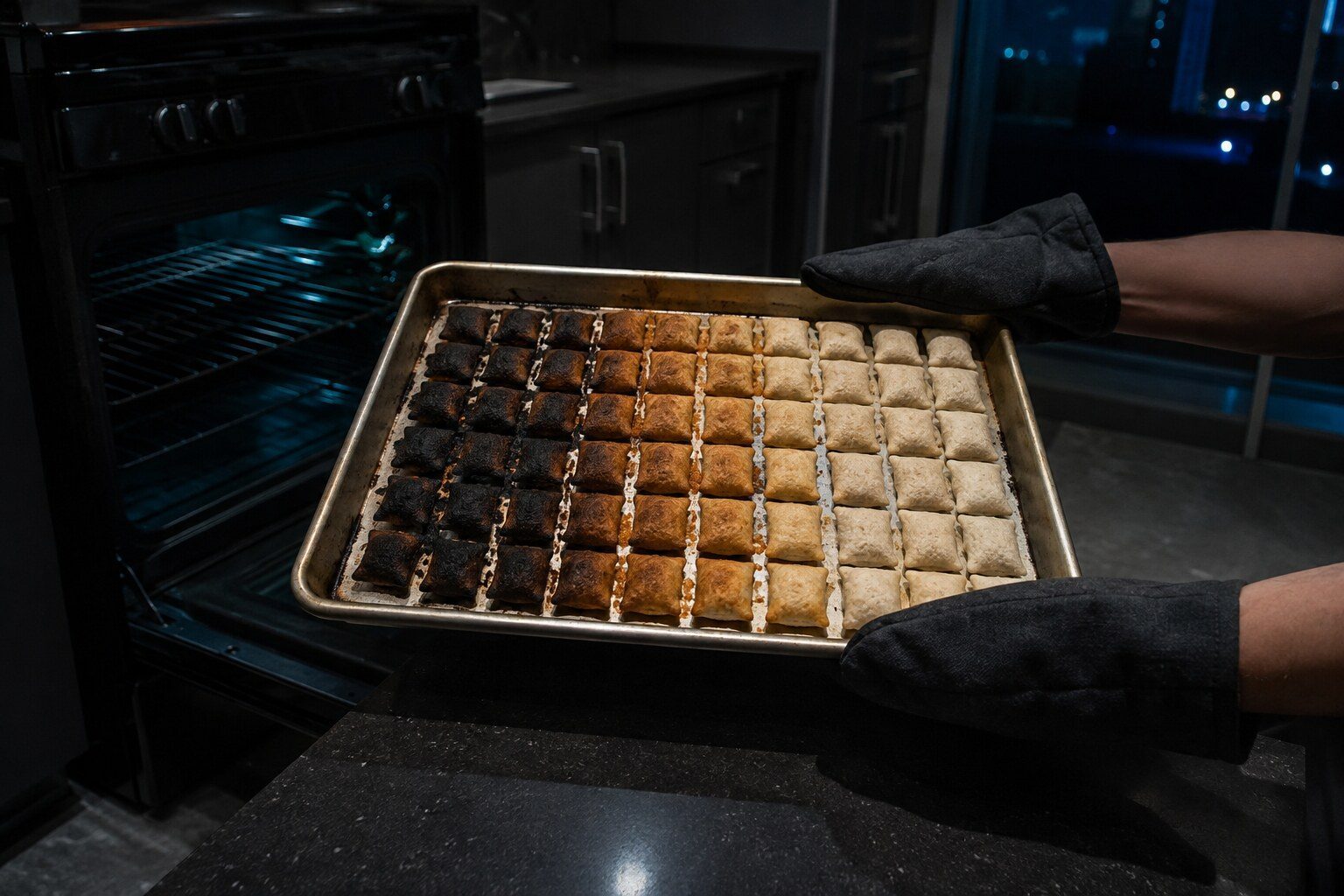
Whirlpool takes this seriously enough to publish separate pages for an oven that is too hot, an oven that is too cold, and — importantly — for each of those both before and after calibration. That distinction is the whole diagnosis: an oven that is out by a consistent amount is a calibration question, and an oven that is out by a different amount every time is not.
- From $89 diagnostic, credited to the repair
- 59 cities and neighborhoods covered
- OEM parts available on order
- In writing the price, before anything is opened
Five ordinary causes
What this usually turns out to be
Cheapest and commonest first, which is also the order we check them in. They sit hundreds of dollars apart, and only the unit settles which one is yours.
-
Calibration drift
Ovens drift with age. Whirlpool provides an adjustment for exactly this and publishes how to decide whether it is needed.
Oven temperature calibration and sensor service from $125 -
The oven temperature sensor
The probe in the cavity that the control reads. When it reads high, the oven runs cold, and the error is rarely consistent.
Oven temperature calibration and sensor service from $125 -
A door that no longer seals
A tired gasket or a hinge that has dropped lets heat out at the top. The oven overshoots trying to keep up.
Oven door and hinge repair from $175 -
A partly failed element
An element working on part of its length heats unevenly rather than not at all. Browning on one side is the giveaway.
Oven not heating repair from $155 -
Convection settings, not the oven
A recipe temperature used without the convection conversion, or a conversion applied twice. Free to fix and very common.
Diagnostic visit from $89
In five minutes
Before you call anybody
None of it needs tools, and all of it makes the visit shorter.
-
01
Use a thermometer, not a recipe
Baking results are affected by the pan, the rack and the recipe. A thermometer is affected by the oven.
-
02
Test at two temperatures
Out by the same amount at 350 and 450 is calibration. Out by different amounts is the sensor.
-
03
Check the door with a sheet of paper
Close it on a strip of paper and pull. If it slides out easily anywhere along the seal, heat is leaving there.
-
04
Note whether it is new behavior
An oven that has always browned unevenly may simply be that oven. One that changed last month has a cause worth finding.
How it shows up
What people describe when they call
A shortcut
Narrow it down before anybody arrives
A description of the behaviour leaves a few possible causes. A code names the subsystem before anybody opens anything, which is why it is worth photographing before it clears.
If there is no code at all
WERE3000SB
WERP3100PS
WFC130M0AW
WFE320M0AB
WFG510S0AW
GERC4110SQ
GW395LEGT
GY395LXGQ
WGE745C0FE
WFG745H0FE
GBS277PDT
RBS245PDT
The data plate is inside the cabinet, upper left wall or behind the grille. All models
In more detail
About Whirlpool oven runs hot or cold
Measure it before you adjust anything
Put an oven thermometer on the middle rack, set the oven to 350 and leave it for twenty minutes after the preheat tone. Read it, then read it again ten minutes later. An oven that sits steady at 325 is out by a consistent 25 degrees and that is what calibration exists for. An oven that swings between 300 and 400 is not a calibration problem at all — it is a sensor or a control that cannot hold a temperature, and adjusting the calibration on top of that makes it harder to diagnose later, not easier.
What it usually means, by the kind of machine
Whirlpool sells one appliance in several forms — a top-loader with an agitator and one without, a front-loader, a stacked pair, a laundry tower and an all-in-one; a vented dryer, a ventless one and a heat pump — and the same behavior points at different things on each of them. A top-load washer has no drain pump filter to open and a front-loader does, which is the whole first hour of the same complaint on two machines.
- Freestanding range — The cavity is shallower and the door is larger in proportion, so heat loss at the door affects the top of the oven first. Uneven browning front to back often starts here.
- Wall oven — Whirlpool's own pages split wall-oven temperature problems four ways, by direction and by whether calibration has already been done. Say which applies when you book.
- Convection models — A convection conversion that has not been applied is a very common false report. Whirlpool has a page on telling whether the conversion temperature is correct, and it is worth reading before assuming a problem.
Calibration is not a cure for instability
Whirlpool's own structure on this makes the point better than we could: it publishes a page for an oven that is too cold and already calibrated, and a separate one for an oven that is too cold and needs calibration. That split exists because the two are different problems. Calibration shifts the whole scale by a fixed amount and does nothing at all for an oven that cannot hold a steady temperature. Adjusting an unstable oven hides the pattern that would have identified the sensor, which is why we measure before we adjust.
The kitchen is part of the measurement
A range in a South Florida kitchen in August is starting from an ambient temperature the design never assumed, and a wall oven built into a run of cabinets with a blocked vent path is worse. Neither changes what the oven should hold at 350, but both change how long it takes and how hard the element works getting there. When somebody reports that an oven bakes differently in summer, that is worth taking at face value rather than dismissing.
This article is based on:
- Official manufacturer documentation
- Internal repair procedures
- Technician repair history
- Company quality standards
Before you book
Questions about Whirlpool oven runs hot or cold
How far out is normal?
A well-behaved oven holds close to its set point once it has settled, cycling a little either side. A steady difference of more than about 25 degrees is worth correcting, and a swing of 50 or more is worth investigating rather than adjusting.
Everything burns on the bottom.
That points at the lower element or at rack position rather than at calibration. Try the same dish one rack higher first, because if that fixes it the oven is behaving normally and the habit was the problem.
Where we do it
Across Miami-Dade, Broward, and Palm Beach
Same terms everywhere we go: an on-site diagnostic first, the price agreed in writing, and the exact figure confirmed once we have seen the unit.
Neighborhoods people ask for by name