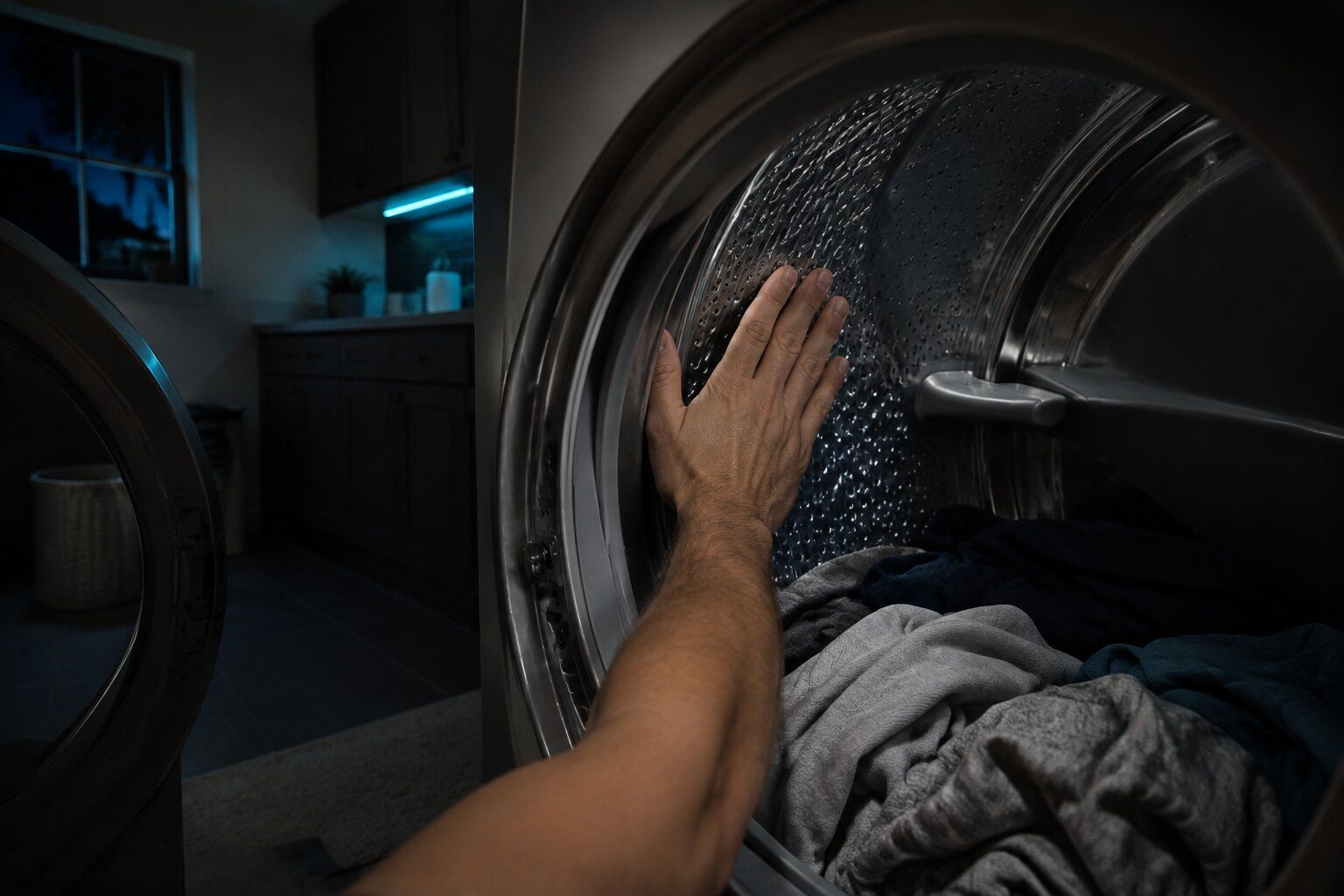
- “F4 E4 and L2 are Whirlpool's low or no line voltage report — that one starts at the panel”
- “F4 E1 is the heater or the heater relays, and that one is inside the machine”
- “An electric dryer on a tripped half-breaker tumbles perfectly and heats nothing”
Symptom
Whirlpool dryer runs but does not heat
A dryer that tumbles without heating has usually lost one of two things: the heat itself, or half of its electrical supply. Whirlpool separates the two in its own table, and the difference decides whether the repair is inside the machine or at the breaker panel.
- From $89 diagnostic, credited to the repair
- 59 cities and neighborhoods covered
- OEM parts available on order
- In writing the price, before anything is opened
Five ordinary causes
What this usually turns out to be
Cheapest and commonest first, which is also the order we check them in. They sit hundreds of dollars apart, and only the unit settles which one is yours.
-
Half the supply is missing
A tripped or failed leg of the double breaker. The drum turns, the panel lights, and there is no heat. Whirlpool codes it F4 E4 or L2.
Diagnostic visit from $89 -
The heating element
The ordinary end of an electric dryer's life. It either opens outright or grounds, and the machine reports F4 E1 on controls that can see it.
Dryer heating element replacement from $175 -
A thermal cutoff that has done its job
Almost always downstream of a restricted vent. Replacing it without clearing the duct means replacing it again.
Dryer vent cleaning from $129 -
The igniter, on a gas dryer
It glows and then has to hold long enough for the valve to open. A weak one gives a cycle with plenty of tumbling and no flame.
Gas dryer igniter and valve repair from $175 -
The inlet thermistor
F3 E3 is Whirlpool's inlet thermistor code — the sensor reading the air going into the drum. A control that cannot read temperature will not commit to heating.
Dryer not heating repair from $145
In five minutes
Before you call anybody
None of it needs tools, and all of it makes the visit shorter.
-
01
Cycle the breaker fully
Off, pause, on. This is free and it settles the whole supply question in under a minute.
-
02
Try a timed cycle rather than an automatic one
An automatic cycle can end early when the sensor is confused. A timed cycle removes the sensor from the argument.
-
03
Listen for the gas valve
On a gas dryer you can hear the click of the valve and see the glow through the vent opening. No glow and no click is the diagnosis.
-
04
Clean the vent before judging anything
A restricted duct overheats the machine and opens a safety device, so the vent gets checked even on a no-heat call.
How it shows up
What people describe when they call

A shortcut
Narrow it down before anybody arrives
A description of the behaviour leaves a few possible causes. A code names the subsystem before anybody opens anything, which is why it is worth photographing before it clears.
If there is no code at all
The data plate is inside the cabinet, upper left wall or behind the grille. All models
In more detail
About Whirlpool dryer runs but does not heat
Check the breaker properly, not just visually
An electric dryer uses a double breaker, and half of it can fail while the other half is still on. The handle usually looks completely normal. Switch the breaker fully off and then fully on again — not a nudge, all the way over — and try another cycle. Whirlpool's own wording on F4 E4 puts this at the house supply rather than at the dryer: low or no line voltage, so the heater cannot come on. If that changes nothing and the drum still turns cold, the heat source is next and that is a visit.
What it usually means, by the kind of machine
Whirlpool sells one appliance in several forms — a top-loader with an agitator and one without, a front-loader, a stacked pair, a laundry tower and an all-in-one; a vented dryer, a ventless one and a heat pump — and the same behavior points at different things on each of them. A top-load washer has no drain pump filter to open and a front-loader does, which is the whole first hour of the same complaint on two machines.
- Electric — Runs on two 120-volt legs. Lose one and the motor still runs on the other while the element gets nothing. That is why a dryer can look completely healthy and produce no heat at all.
- Gas — The igniter glows, the valve opens, the flame lights. When the igniter weakens, the dryer tumbles a full cycle with no flame and no code on many models.
- Compact heat pump — Makes heat with a refrigerant circuit rather than an element, so a cold load here points at the sealed system or a blocked condenser rather than at a heater.
Two halves of one supply
This catches people constantly and it is worth understanding, because it is the one cause where nothing inside the dryer is wrong. An electric dryer is fed by two live legs. The motor, the drum light and the control run on one. The heating element needs both. When a leg is lost — at the breaker, at a loose connection in the outlet, occasionally out at the meter — the dryer looks entirely healthy and dries nothing. Whirlpool's own page for F4 E4 says as much, which is unusually direct for a maker's code table and worth quoting when somebody has already been sold an element.
The part that is easy on this badge
Whirlpool is the volume brand of its own corporation, and the practical result on a no-heat dryer is that the element, the thermostats, the thermal cutoff and the gas igniter are ordinary stocked parts. That is the difference between a repair booked today and a repair waiting a week on a part from a specialist, and it is the honest advantage of owning the most common machine in the state.
This article is based on:
- Official manufacturer documentation
- Internal repair procedures
- Technician repair history
- Company quality standards
Before you book
Questions about Whirlpool dryer runs but does not heat
It heated yesterday and not today.
Elements and igniters do fail exactly like that, with no warning at all. So does a breaker leg. Cycle the breaker first, because it is free, and then book if nothing changes.
The dryer is hot to touch but the clothes are cold.
That is heat being made and not moved, which is a vent problem rather than a heating problem. Different repair, and the vent is where we would start.
Where we do it
Across Miami-Dade, Broward, and Palm Beach
Same terms everywhere we go: an on-site diagnostic first, the price agreed in writing, and the exact figure confirmed once we have seen the unit.
Neighborhoods people ask for by name