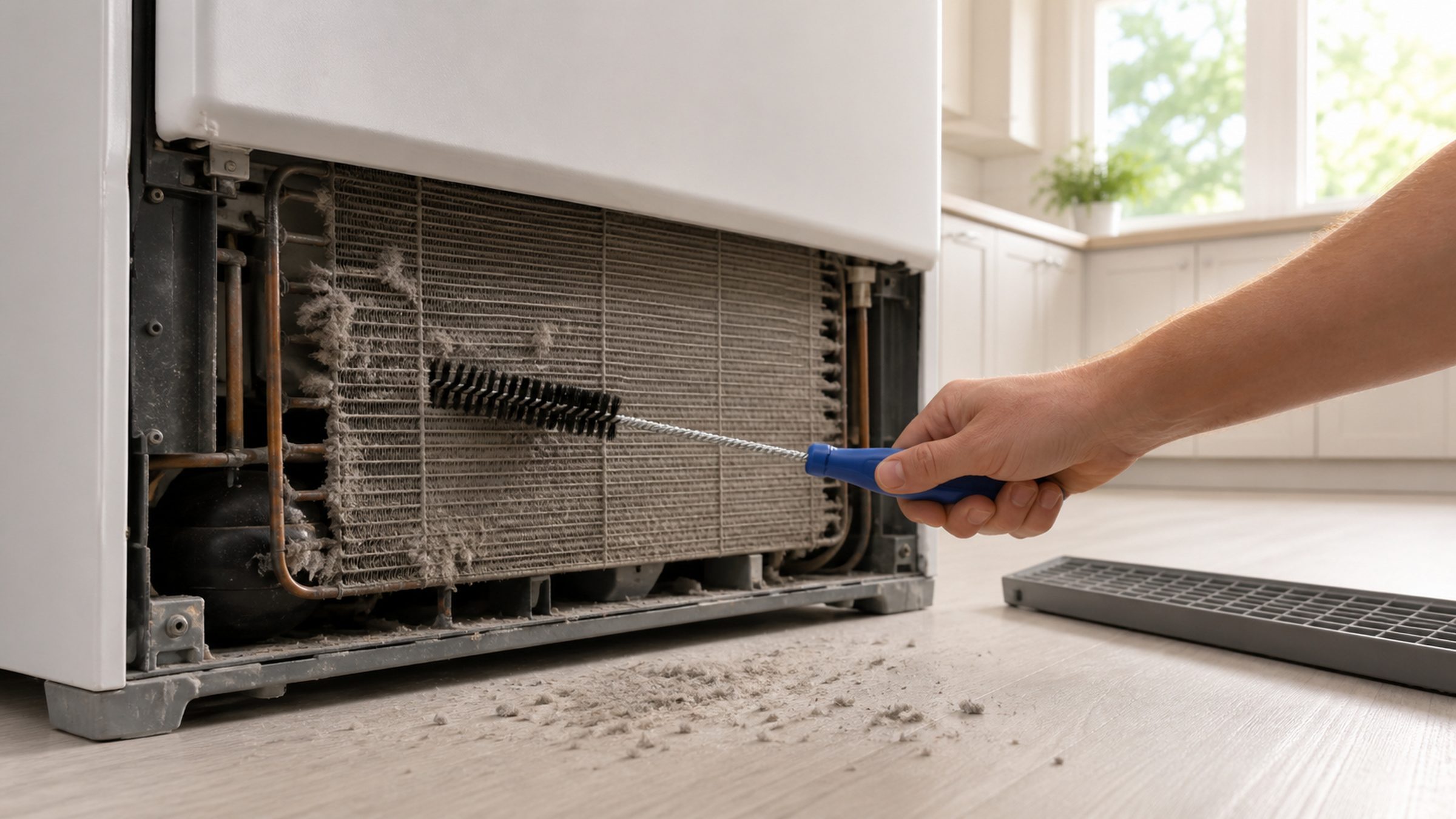
Maintenance & Prevention
Nothing Tells You the Coil Is Dirty, and Five Machines Reach It Five Ways
The condenser is the coil that throws away the heat the refrigerator takes out of the food, and when it is blanketed in dust, pet hair and coastal grime it cannot do it. The compressor then runs longer and hotter for the same cabinet temperature, and the compressor is the one part on this appliance whose replacement approaches the price of the refrigerator. Twenty minutes twice a year is the best-value maintenance on the machine, and almost nobody does it — because nothing on the appliance ever asks. There is no error code for a dirty condenser, no indicator light, no reminder counting the months, and nothing in a connected model's app. The cabinet will count a water filter down to the day and say nothing about the coil. Where the coil is reached is not the same on every machine, and this is the part that must not be guessed: Whirlpool publishes a separate condenser-cleaning page for side-by-side, quad door, French door, top freezer and all-refrigerator cabinets, plus a general page on how and when to clean the coils safely and a video. Find your configuration, read the make's page for that configuration, and then do the work. In South Florida, twice a year, and more often with a pet or a garage installation.
The full guide
Whirlpool refrigerator cleaning condenser coils: the job nothing asks you to do
A refrigerator does not make cold. It moves heat out of an insulated box and dumps it into your kitchen, and the part that does the dumping is the condenser — a coil with fins, and a fan pushing room air across it.
Blanket that coil in dust and it cannot dump heat. The refrigerant leaves the coil warmer than it should, the compressor works against higher pressure, and it runs longer to reach the same temperature inside. Nothing appears to be wrong. The machine is simply working much harder than it was designed to, for years.
Nothing on the appliance is going to mention it
This is the reason the job goes undone in houses where everything else is looked after.
The same cabinet will count a water filter down and light a lamp when it is due. Some of them light a second lamp for the air filter. Where the control is watching a circuit, it will put a code on the display and Whirlpool will publish a page explaining it.
For the condenser there is nothing. No code is published for a dirty coil. No indicator lights for it. No counter runs down. A connected model cannot see it either, because there is no sensor anywhere in the machine looking at that coil.
So an owner who changes the water filter on schedule, reasonably concluding that the appliance asks for what it needs, can have a coil that has not been touched since delivery.
Where the coil is reached is not one answer, and this matters
Here is the part most articles get wrong, and it is worth being careful about.
The access point is not the same on every Whirlpool refrigerator. The make publishes a separate condenser-cleaning page for the side-by-side, for the quad door, for the French door bottom freezer, for the top freezer, and for the all-refrigerator cabinet — plus a general page on how and when to clean the coils safely, and a video.
Whirlpool would not publish five pages if one description covered all five cabinets.
So this guide does not tell you where your coil is, and you should be wary of any guide that tells you without asking what you own. Get the model number off the plate inside the fresh food compartment, establish which of those configurations you have, and read the maker's page for that one. It takes three minutes and it is the difference between twenty minutes of cleaning and an afternoon of taking off panels that were never meant to come off.
Why twice a year here, not once
Manuals aimed at the whole country tend to say annually. South Florida is not the whole country.
Humidity nine months of the year. Damp dust does not float away. It sticks to a fin and stays there, and the next layer sticks to that.
Salt in the air. Near the water it gets into everything, and it makes the deposit on a coil denser and greasier than ordinary house dust.
Air conditioning that never really stops. A house with air moving through it twelve months a year is a house circulating dust twelve months a year, and the condenser fan is a very effective filter that nobody empties.
The garage. A second refrigerator in a South Florida garage is normal, and it is the hardest environment in the house: hot ambient air, no air conditioning, and every kind of grit. A garage machine wants doing more often than a kitchen one and it is the one most likely never to have been done at all.
Pets. A house with a dog or a cat can pack a coil in about a year on its own. Hair mats into the fins rather than sitting on them.
What it is actually protecting
Be clear about the stakes, because twenty minutes of kneeling on a tile floor deserves a reason.
A hot, hard-working compressor is a compressor with a shorter life. When it goes, the repair involves the sealed refrigeration circuit, and that is the one job on this appliance whose figure approaches what the machine cost new. On a Whirlpool — a mainstream refrigerator rather than a five-figure built-in — that is very often the point at which the honest answer is a new machine.
Everything else on this appliance is worth repairing. The compressor is the one that ends the conversation, and the coil is the cheapest thing standing between you and it.
What you will notice afterward
Not much, and that is correct. A clean condenser does not make the refrigerator colder — the thermostat was always going to reach its setpoint if it could. What changes is the effort.
Shorter run cycles. A quieter kitchen at night. Less warmth radiating off the sides of the cabinet. A little less on the electricity bill, though nobody should promise a figure.
And on a machine that had drifted — the freezer solid while the fresh food side sat a few degrees too warm — sometimes the drift simply stops, because a marginal condenser is one of the ordinary causes of it.
When to stop and call instead
Three situations where this stops being a household job.
The fan is not turning when the compressor runs. That is a repair, not a cleaning, and running the machine that way cooks the compressor.
The coil is oily rather than dusty. Oil on a condenser means refrigerant and oil have been somewhere they should not be. Do not clean it and do not run it.
It still runs constantly a day after a proper clean. Then the coil was not the problem, or not the only one, and the next steps are measurements — temperatures at the coil, air across it, current at the compressor — rather than more cleaning.
We will tell you which of those you have before anything is opened, and if the answer is that the machine is not worth repairing, we will say that too.
If it turns out to be a repair
What this leads to, and what it costs
Every job on this site is priced the same way: an on-site diagnostic first, the figure agreed in writing before anybody starts.
-
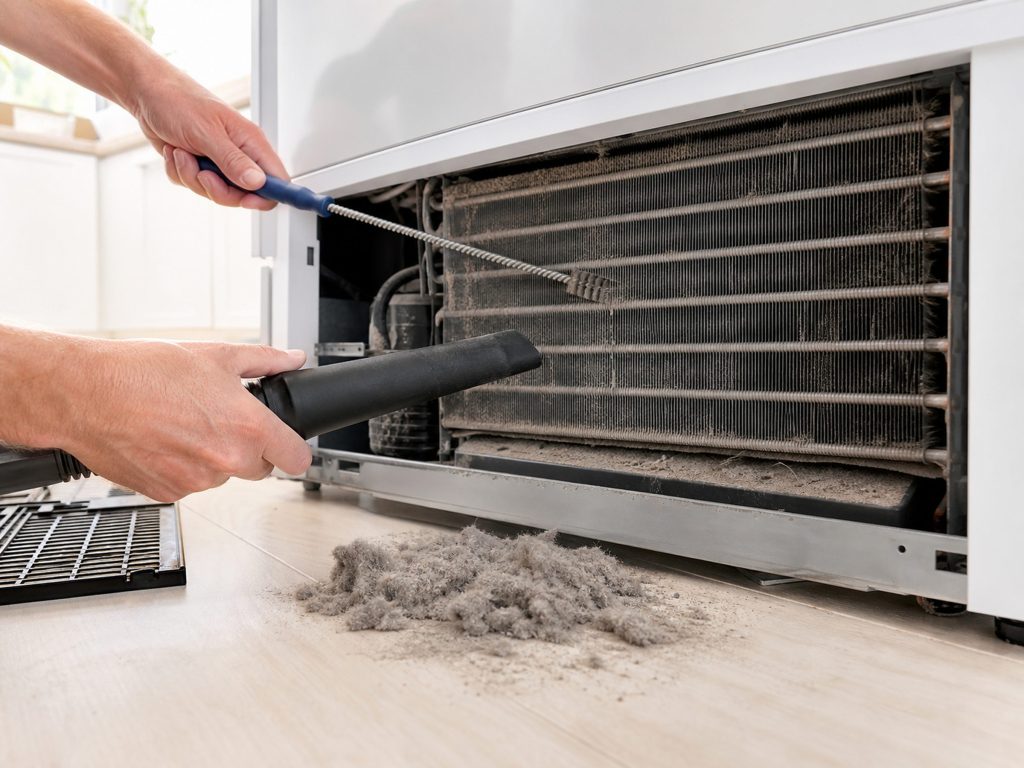
from $115 Condenser cleaning service
Nothing on a Whirlpool will ever tell you the coil is blocked. This make publishes a cleaning-the-condenser page for its top-freezer refrigerators and not one code page for them, so the condition is invisible until the compressor is running almost continuously and the ice cream starts going soft. The machines that need this most are the ordinary ones — the top-freezer in a rental condominium that has not been pulled away from the wall since the day it was delivered.
- There is no code for a blocked coil on this make, so somebody has to go and look
- Top-freezer and side-by-side cabinets, where a toe grille hides most of the coil
- Compressor run time recorded on the visit, so next year has something to compare with
-
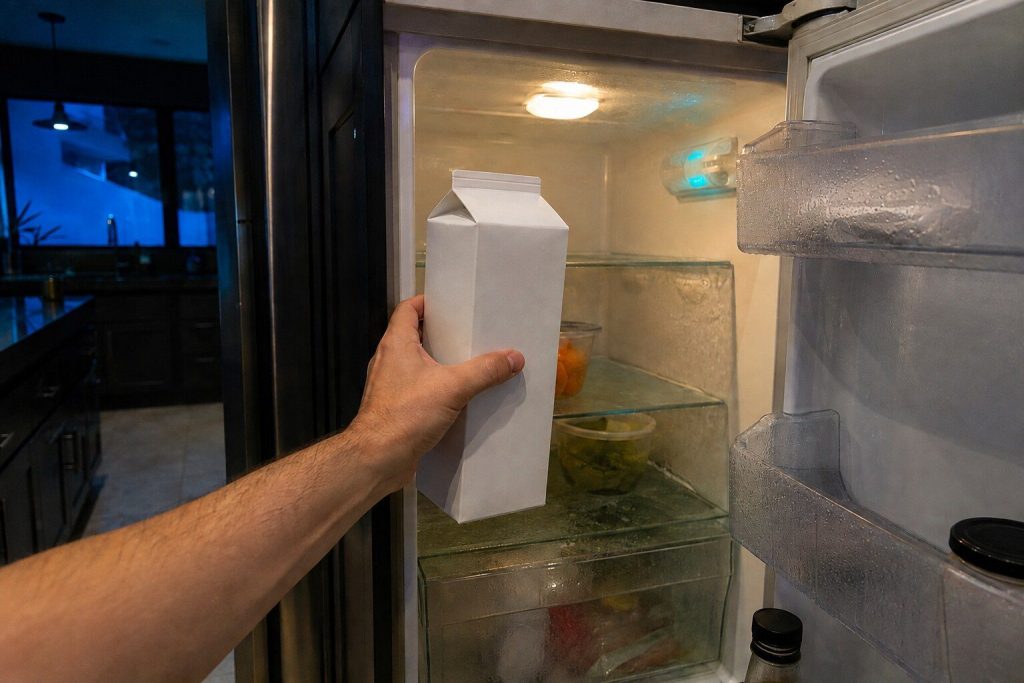
The lights are on, the panel looks normal, and the food is warm Refrigerator is not cooling
This is where Whirlpool goes quiet. Its top-freezer branch publishes 82 pages and not one error code; its side-by-side branch publishes 140 pages and nine. Where an F code does appear on a refrigerator, the maker publishes the fact that an F is flashing and, on the pages behind it, does not publish what each one means. So this diagnosis is measured, not read.
- Whirlpool publishes almost no refrigerator codes, and does not publish meanings for the F codes it does show
- PO is one of the few real messages: the power was off long enough to matter
- A condenser in a Miami garage is doing a much harder job than the design assumed
-
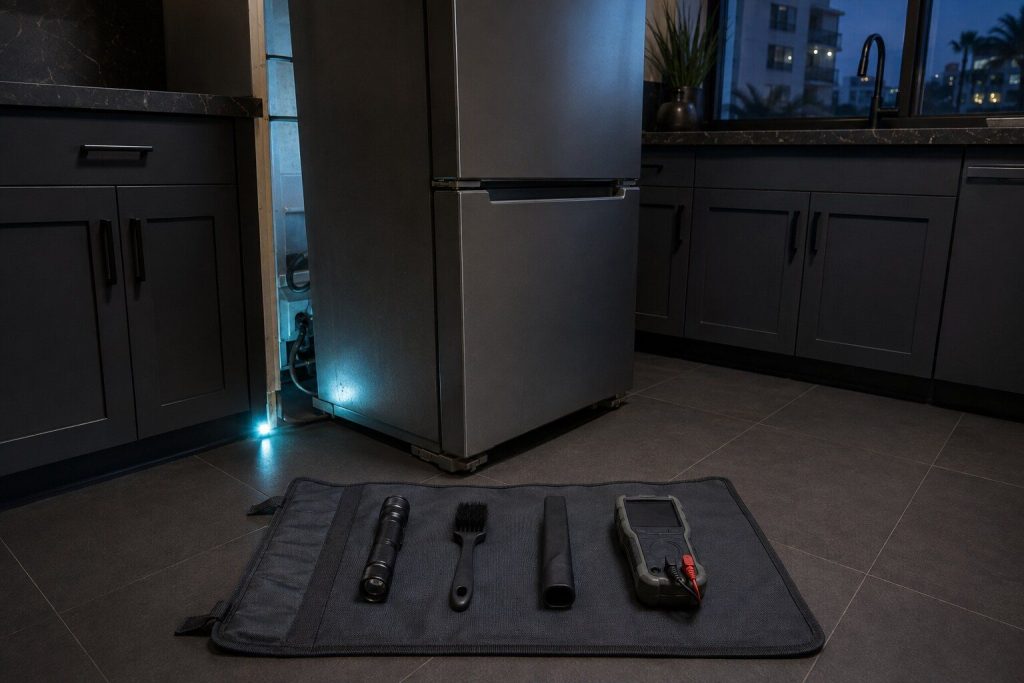
from $119 Appliance maintenance
Nothing on this list saves an owner more money and nothing is booked less often. Whirlpool builds appliances that will run for fifteen years in an ordinary house, and what usually ends them early is a maintenance item rather than a design one: a coil under a blanket of dust, a drain pump filter that has never once been opened, a duct that has closed a little further every year. This make publishes cleaning instructions for every one of those. Almost nobody has read them.
- One visit across everything you own, priced on time rather than per machine
- The washer drain pump filter, which is the most neglected part in South Florida
- You keep a written list of what is closest to failing
Questions people ask about this
Where are the coils on my refrigerator?
That depends on which cabinet you have, and it is worth being exact rather than approximate. Whirlpool publishes a separate cleaning page for each configuration — side-by-side, quad door, French door bottom freezer, top freezer and all-refrigerator — because the access point is not the same on all of them, and there is a general page on how and when to clean the coils safely as well as a video. Read the page that matches your model rather than a general description, and if you cannot tell which you have, the model number on the plate settles it.
How do I know it needs doing?
You do not, and that is the whole point of this guide. The appliance has no way to report it: no code is published for it, no indicator lights for it, nothing counts the months, and a connected model cannot see it either. What you get instead are second-hand signs — the machine running almost continuously, the cabinet warm at the sides, the kitchen warmer than it used to be, or a freezer that is fine while the fresh food side drifts. By the time those show, the coil has been packed for a while.
Does whirlpool refrigerator cleaning condenser coils really change anything?
It changes how hard the compressor works and how long it runs, and those are the two things that decide how long it lasts. A coil that cannot shed heat forces longer run times at higher head pressure, which is a slow, quiet way of wearing out the single most expensive part in the box. Nobody can promise a number of extra years. What can be said is that of everything an owner can do to this appliance without tools, this is the one with the best return.
Twice a year seems like a lot.
It is a lot compared with the once a year most manuals suggest, and the difference is the climate. Nine months of humidity, salt in the air near the water, and air conditioning that runs all year and moves household dust continuously all load a coil faster here than in a dry inland kitchen. In a house with a dog or a cat, a coil can pack solid inside a year on its own.
Can I just blow it out with compressed air?
It moves the dust rather than removing it, and in a kitchen it moves it onto everything. Use a vacuum with a brush head to take away what is loose, and a long flexible coil brush to bring the rest out of the fins toward you. Work along the fins, never across them — bent fins block airflow permanently and are much harder to fix than dust.
Maintenance & Prevention
More guides like this one
-
The Filter Whirlpool Files Under Not Draining, and What That Tells You
Poor cleaning and poor draining have one cause in common, and it twists out by hand. Nobody told the owners of the newer machines that a chore had appeared.
Read more -
You Clean the Lint Screen Every Load. That Is Not the Part That Blocks.
The screen catches what it catches. The rest goes down the duct, which is why a machine with a spotless screen can still be starving for air.
Read more -
How Long a Whirlpool Refrigerator Water Filter Really Lasts in South Florida
Six months is the label, and the label assumes water that is not this. The half nobody publishes is what the machine does for the day after you change it.
Read more
Tell us the model number and what it is doing.
This article is based on:
- Official manufacturer documentation
- Internal repair procedures
- Technician repair history
- Company quality standards