Maintenance & Prevention
The Filter Whirlpool Files Under Not Draining, and What That Tells You
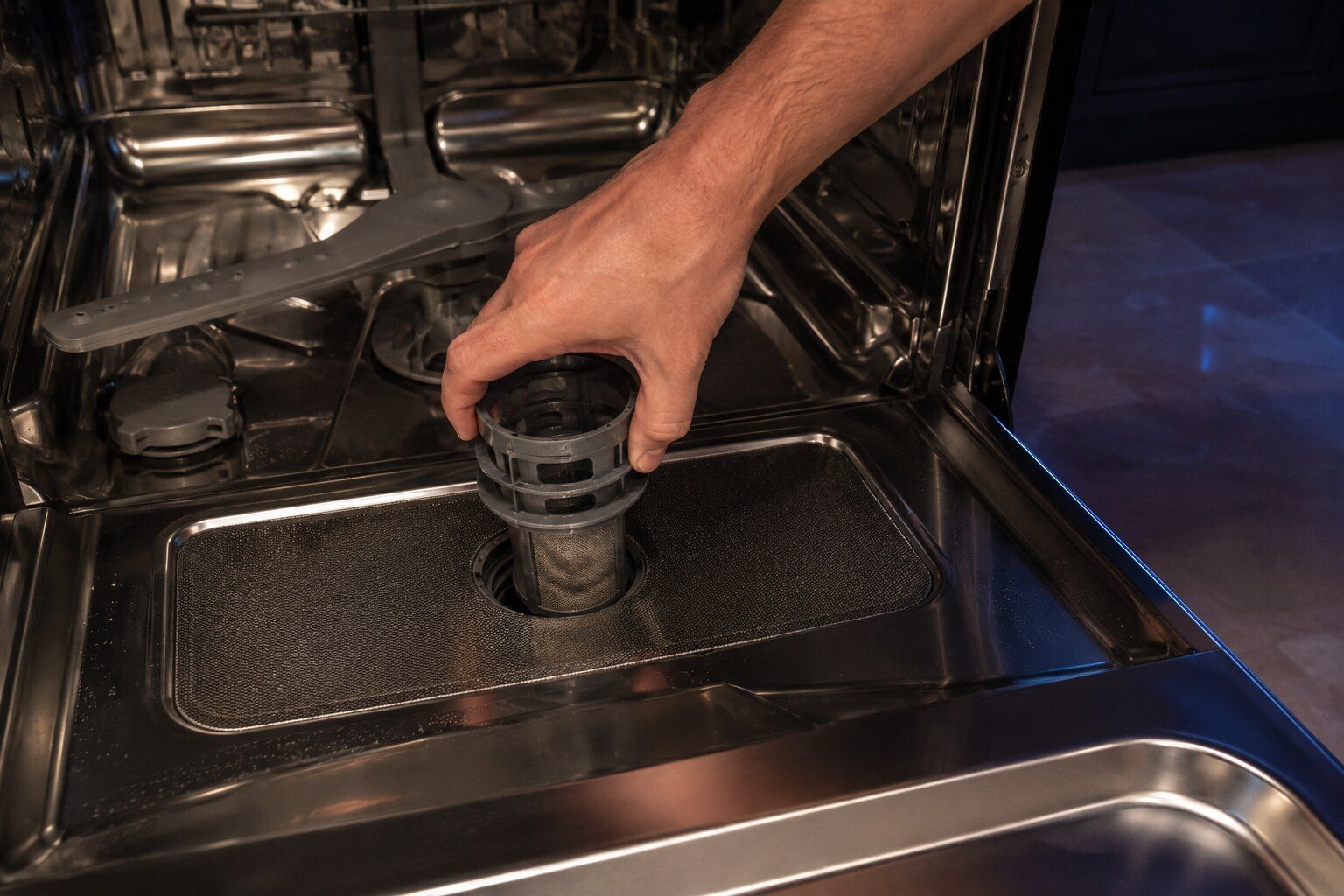
Every four to six weeks for a household running the machine daily, and twice a year at the absolute minimum. The filter sits in the floor of the tub under the lower rack, it comes out by hand in about five minutes, and it is the highest-value maintenance in the kitchen. It matters more on this make than it used to because Whirlpool moved away from the hard food disposer that ground waste up and toward a removable filtration system that catches it and holds it — a genuinely better design, much quieter, and nobody told the owners of the newer machines that a new chore had appeared with it. When the filter packs, two things happen at once. The pump can no longer draw clean water, so plates come out gritty. And the same restriction slows the drain, so water sits in the sump between cycles and the machine begins to smell. Whirlpool's own base files water remaining in the filter area under not draining, which is the same observation from the other direction. The job needs no tools: a raised cylinder turns about a quarter turn counterclockwise and lifts out, and there is a flat screen underneath it that most people never notice.
The full guide
How often should I clean my Whirlpool dishwasher filter? Sooner than you think
Every four to six weeks if the machine runs daily. Twice a year is the absolute floor, and twice a year in this water is already a compromise.
That is a shorter interval than most manuals suggest, and the reason is not the appliance. It is that Miami water is hard, a mineral film builds on the mesh, and everything that lands on the mesh afterward sticks to that film instead of rinsing off it.
Two complaints, one cause
People call about two things that sound unrelated.
*The plates come out with grit on them.* And: *there is always a little water in the bottom, and it has started to smell.*
They are usually the same problem.
A dishwasher recirculates its wash water. The same water is thrown at the dishes, drains back through the filter into the sump, and is pumped up and thrown again. Everything it picks up on the way has to be caught somewhere, and the somewhere is the filter.
When the filter packs, the pump can no longer draw clean water. So the machine is spraying its own soil back onto the load. That is the grit.
The same restriction slows the drain. So water sits in the sump between cycles. Warm, still, and carrying what the filter did not hold. That is the smell.
Whirlpool's own support base makes the connection without comment: *water remains in the filter area* is filed under not draining. The maker is telling you where standing water comes from, in the section title.
The change nobody announced
This deserves its own paragraph, because it is why so many owners of this make have never done the job.
The previous generation of dishwashers ground food waste up. A hard food disposer sat in the sump doing what a garbage disposal does — noisily — and the owner's entire maintenance obligation was to not put a teaspoon down there.
The current generation catches the soil instead and holds it in a removable filtration system. That is why these machines are quiet enough to run while you are in the room. It is a better design in every respect but one: it created a chore, and the chore was not on the delivery driver's list of things to mention.
So there is a large population of perfectly good Whirlpool dishwashers in South Florida, five and eight and ten years old, whose owners have never once taken the filter out — and who conclude, entirely reasonably, that the machine has got worse with age.
What comes out of one
Be prepared. A filter in a household that puts plates in without a rinse holds a compacted mat of starch, fat and fiber, and in hard water that mat is bound together by mineral scale.
Under it, in the sump recess, is the other half of the story: glass chips from a broken tumbler somebody thought they had swept up, olive and cherry pits, fruit stickers, and the paper labels off jars. None of that is stopped by a filter mesh. It sits in the recess and waits.
Glass grit is the one that costs money. It gets past the filter when the filter is not locked down properly, reaches the pump, and takes the impeller and the seal with it. That is the difference between a five-minute job at the sink and a drain-and-pump repair.
The half people leave behind
There are two parts, and almost everybody who has done this once has only done half of it.
The raised cylinder in the middle is the obvious one. It turns about a quarter turn counterclockwise and lifts straight out. When it will not move, the reason is nearly always that somebody is pulling up instead of twisting.
Underneath it there is a flat screen, lying in the floor of the tub. On some machines it lifts out separately, on others it is joined to the cylinder. That flat screen is the fine filter, and it is the one that actually restricts. A cylinder rinsed under the tap and put back over a blocked screen changes nothing, and the owner concludes that the filter was not the problem.
Take both. Wash both. Look at the sump while they are out.
Putting it back is the part that matters
The screen seats first, and it has to lie flat with nothing standing proud of the tub floor. Then the cylinder drops into the center and turns clockwise until it stops.
Then tug it. It should not lift.
A cylinder left crooked or unlocked does not merely filter badly — it lets the wash water bypass the filter completely, which is worse than having no filter at all, because everything now goes to the pump. If the cylinder fights you on the way back, the screen underneath is not seated. Take both out and start again.
Ten minutes twice a year that are worth more than any of this
While the filter is out, two more things are free.
Run a hot cycle with the machine empty, with a dishwasher cleaner or a cup of white vinegar on the top rack. In hard water this keeps the scale from setting on the mesh in the first place, and it makes the next filter clean easier than this one.
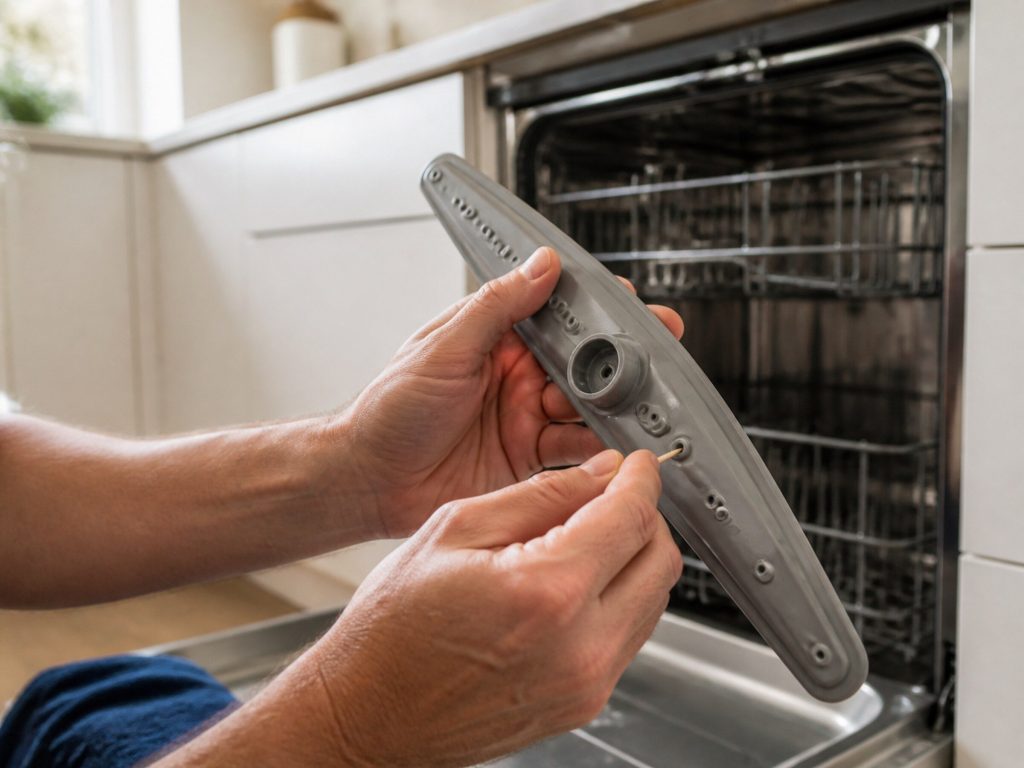
Check the spray arm holes. Take the lower arm off — most of them unclip or unscrew by hand — and hold it up to the light. Blocked holes are the second cause of gritty plates, and the things blocking them come from the same place as everything in your filter.
If the plates are still gritty after all of that, then the machine has a wash performance problem rather than a maintenance one, and that is a different conversation with a pump, a spray arm bearing or a water inlet in it.
If it turns out to be a repair
What this leads to, and what it costs
Every job on this site is priced the same way: an on-site diagnostic first, the figure agreed in writing before anybody starts.
-
Film on the glasses, grit on the plates, the load coming out no better than it went in Dishwasher is not cleaning the dishes
This is rarely one thing. A Whirlpool dishwasher cleans with hot water, pressure and detergent that has to be released at the right moment, and all three can drift at once. Whirlpool codes the water temperature side of it as F4 E2 and the foam side as F6 E3, and everything else on this page is water reaching the dishes or not.
- Spray arms that will not turn freely are the first check and cost nothing
- F4 E2 is Whirlpool's heating error, and a dishwasher without heat cannot clean grease
- Dish soap instead of dishwasher detergent produces foam the machine reports as F6 E3
-
Water standing in the bottom when the cycle ends Dishwasher will not drain
Whirlpool's own label for this is Long Drain, and the machine reports it as F9 E1 — or, on a dishwasher with no display, as nine flashes of the Clean light, a pause, then one flash. Learning to read those two bursts turns a blinking light into the same information a display would have given you.
- F9 E1 and nine-pause-one are the same report on two generations of the same machine
- Water in the filter recess at the end of a cycle is normal; water covering the floor of the tub is not
- The air gap or the disposer connection is outside the dishwasher and causes this constantly
-
from $119 Dishwasher wash performance service
Dishes coming out dirty or filmed is the complaint with the widest range of causes and the smallest average repair. Spray arms, filter, water temperature, detergent, hardness and loading account for most of it, and Whirlpool devotes 27 pages of its own base to wash performance for exactly that reason. It is diagnosed as a system, not as a part.
- Twenty-seven pages of this make's own base are about wash results, and they are not all the machine
- Hard water here leaves film that reads exactly like a broken dishwasher
- Priced on time, and it frequently ends with no part at all
Questions people ask about this
How often should i clean my whirlpool dishwasher filter in Miami water?
Every four to six weeks if the machine runs daily, and every couple of months for lighter use. The interval here is shorter than the manual suggests for two reasons that have nothing to do with the appliance: the water is hard, so a mineral film builds on the mesh and holds the soil that lands on it, and households in this climate rinse less under the tap than they think they do. If you have never done it and the machine is more than a year old, expect what comes out to be memorable.
My dishwasher is a newer one. Does it even have a filter?
Almost certainly yes, and that is the change that caught a generation of owners out. The older design ground food waste up with a hard food disposer and asked nothing of anybody. The current one catches the soil in a removable filtration system instead, which is why these machines are so much quieter, and the filter is the price of the quiet. Whirlpool publishes a cleaning procedure for both the filter and the removable filtration system.
Will cleaning it fix my draining problem?
Often, and it is always the first thing to check because it costs nothing. Whirlpool's own base has a page for water remaining in the filter area filed under draining problems, which tells you how routine this is. If the machine still holds water after the filter is clean, the next places are the drain hose loop behind the machine, the air gap at the sink where one is fitted, and on a recently installed unit the disposer knockout plug — a plug nobody removed means the machine has never been able to drain at all.
Can I put the filter through a cycle in the machine?
No, on two counts. It needs mechanical scrubbing under running water, because a wash cycle will not shift the film that forms on the mesh. And you cannot run the machine with the filter out anyway — everything the filter would have caught goes straight into the pump instead.
It will not lock back in.
Do not force it and do not run a cycle until it does. The flat screen goes in first and has to lie flat with nothing proud of the tub floor. Then the cylinder drops into the center and turns clockwise until it stops. If the cylinder fights you, the screen underneath is not seated. A cylinder left crooked lets soil past the filter entirely, which turns a five-minute job into a pump.
Maintenance & Prevention
More guides like this one
-
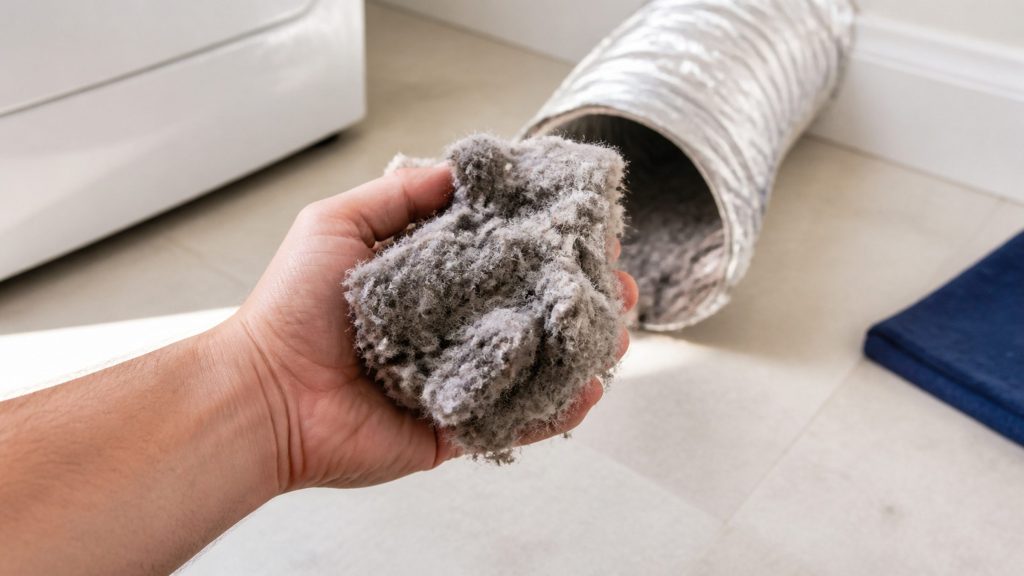
You Clean the Lint Screen Every Load. That Is Not the Part That Blocks.
The screen catches what it catches. The rest goes down the duct, which is why a machine with a spotless screen can still be starving for air.
Read more -
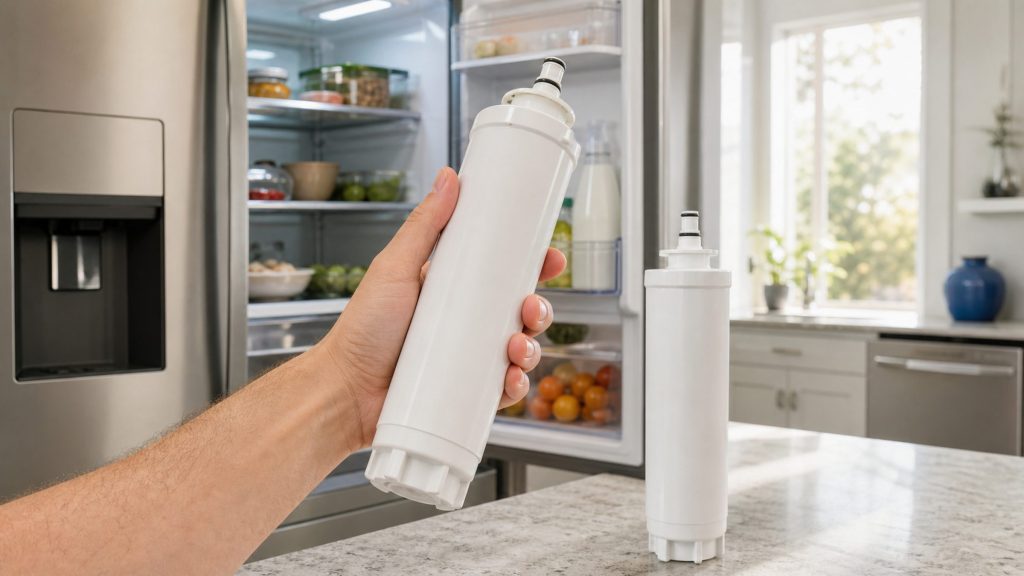
How Long a Whirlpool Refrigerator Water Filter Really Lasts in South Florida
Six months is the label, and the label assumes water that is not this. The half nobody publishes is what the machine does for the day after you change it.
Read more -
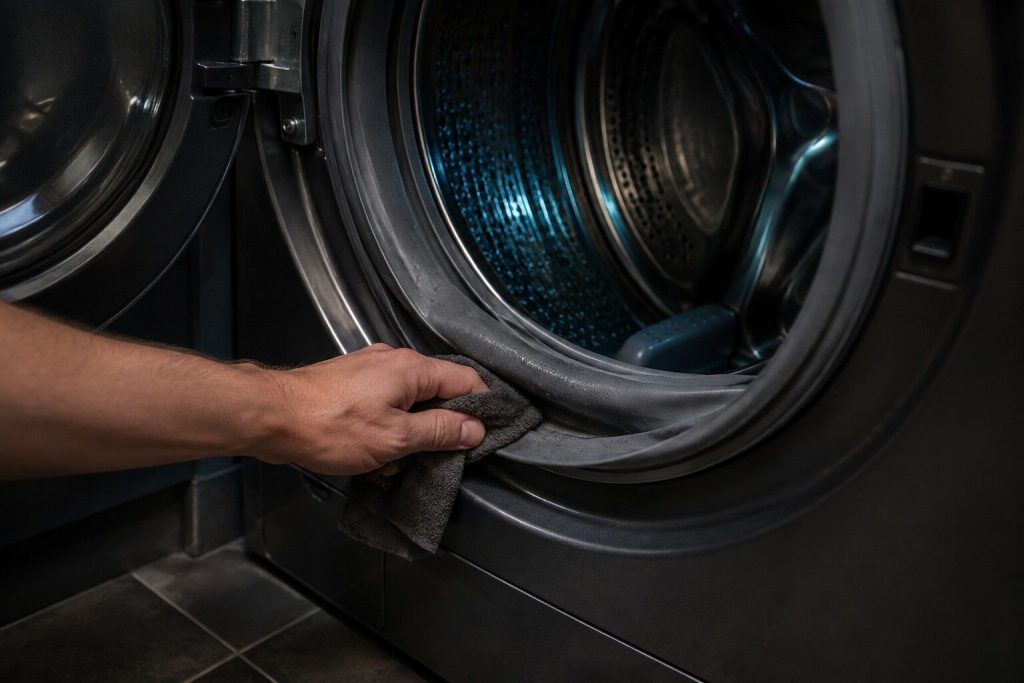
How Often a Whirlpool Washer Actually Needs Cleaning in Florida
The machine asks on a load count, not a calendar. In this climate the count is a floor rather than a target, and the two places that matter are not in the drum at all.
Read more
Tell us the model number and what it is doing.
This article is based on:
- Official manufacturer documentation
- Internal repair procedures
- Technician repair history
- Company quality standards