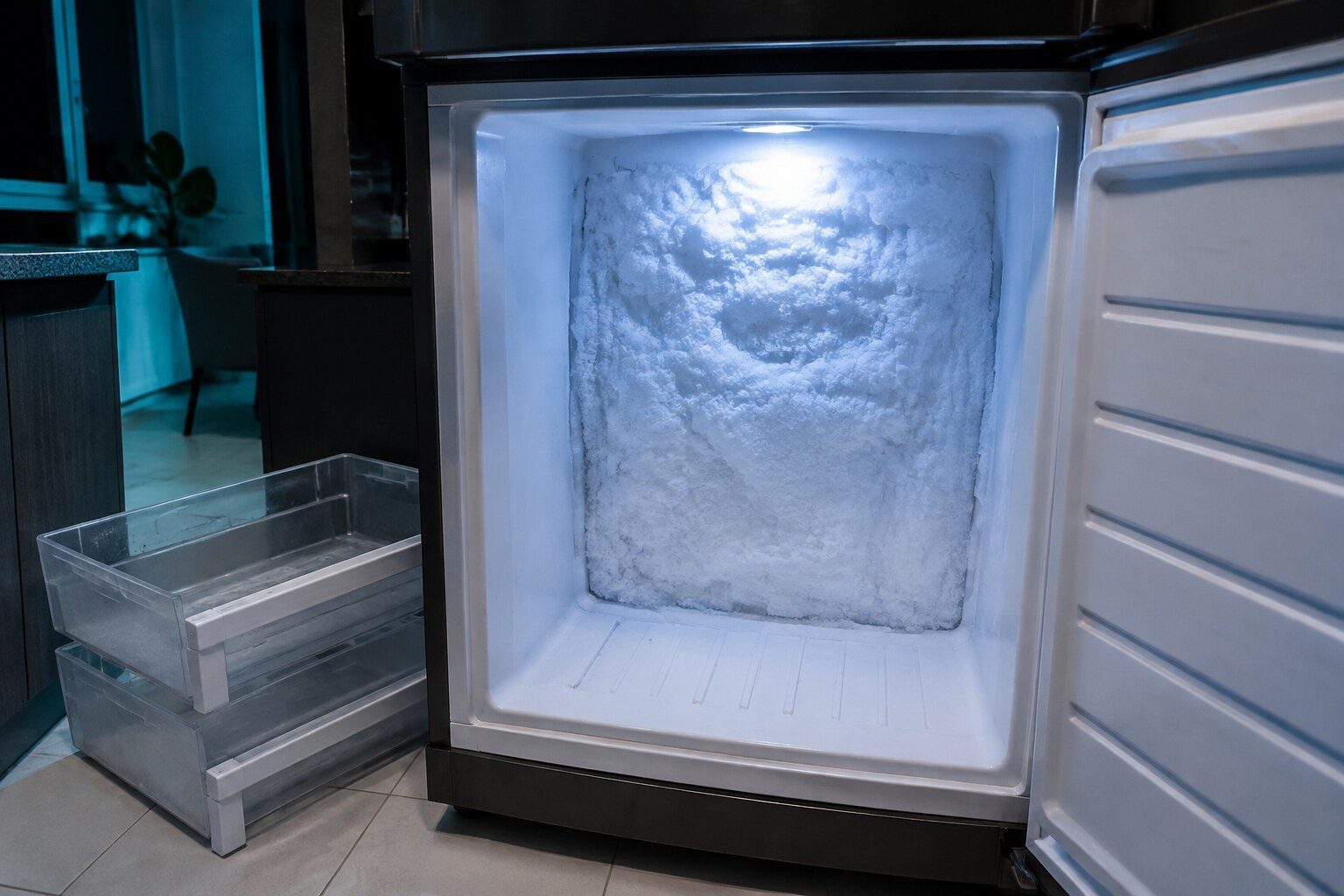
- “Frost on the freezer back wall is the defrost circuit; frost on the food is a door habit”
- “Condensation on the outside of the doors is humidity, not a malfunction”
- “The paper test on the seal takes ten seconds and settles a lot of these”
Symptom
Whirlpool frost inside, or the outside is sweating
Whirlpool publishes five pages on frosting and condensation across its refrigeration branch and no code for any of it, which is fair: these are things you see rather than things the machine measures. In South Florida both of them are more common than the design assumed, because both are driven by the amount of water in the air around the appliance.
- From $89 diagnostic, credited to the repair
- 59 cities and neighborhoods covered
- OEM parts available on order
- In writing the price, before anything is opened
Five ordinary causes
What this usually turns out to be
Cheapest and commonest first, which is also the order we check them in. They sit hundreds of dollars apart, and only the unit settles which one is yours.
-
The defrost circuit
A heater or sensor that no longer clears the evaporator. The back wall ices up, airflow dies, and the fresh food side goes warm weeks later.
Defrost system repair from $165 -
A door seal that grips weakly
Warm damp air arriving continuously. In this climate it makes frost inside and water outside at the same time.
Refrigerator door seal replacement from $135 -
A door left ajar
Whirlpool's alarm sounds after two to five minutes depending on the model. A bottle on a shelf edge or a drawer not quite home is enough.
Diagnostic visit from $89 -
The room itself
A closed-up house in August, or a garage installation. A cold cabinet in humid air will sweat and there is nothing wrong with it.
Diagnostic visit from $89 -
Door heaters, on models that have them
Some cabinets warm the door edges deliberately to stop condensation. When that circuit stops, sweating appears in a consistent line.
Refrigerator not cooling repair from $145
In five minutes
Before you call anybody
None of it needs tools, and all of it makes the visit shorter.
-
01
Look at where the frost is
Back wall, evenly — defrost. On the food and the shelves — air getting in. That distinction is most of the diagnosis.
-
02
Do the paper test on every door
All the way around each one. The bottom corners fail first, and they are the hardest to see.
-
03
Watch the doors close on their own
They should swing shut from a few inches and seat firmly. One that stops short is not level or has a dropped hinge.
-
04
Note whether the house is being cooled
A property left unoccupied with the air conditioning off is a different environment, and it explains a lot of seasonal sweating calls.
How it shows up
What people describe when they call
A shortcut
Narrow it down before anybody arrives
A description of the behaviour leaves a few possible causes. A code names the subsystem before anybody opens anything, which is why it is worth photographing before it clears.
If there is no code at all
The data plate is inside the cabinet, upper left wall or behind the grille. All models
In more detail
About Whirlpool frost inside, or the outside is sweating
Separate the two before doing anything
Frost inside and sweat outside are opposite problems. For frost, look at where it is: an even sheet across the back wall of the freezer is the defrost circuit and it needs a technician; frost on the food and on the top surfaces is warm air getting in, which means a door or a seal. For sweating on the outside of the cabinet, hold a sheet of paper in the door and pull it: if it slides out easily anywhere, that stretch of seal is not sealing. And check the kitchen itself — a house left at 80 degrees with the air conditioning off while nobody is home will sweat any refrigerator in the state.
What it usually means, by the kind of machine
Whirlpool sells one appliance in several forms — a top-loader with an agitator and one without, a front-loader, a stacked pair, a laundry tower and an all-in-one; a vented dryer, a ventless one and a heat pump — and the same behavior points at different things on each of them. A top-load washer has no drain pump filter to open and a front-loader does, which is the whole first hour of the same complaint on two machines.
- French door — Two doors and a drawer means three seals and three chances for one to be out of line. A door that closes but does not pull square is the usual culprit.
- Side-by-side — The tall narrow doors are heavy and drop over time. Frost that appears concentrated on one side follows the door that is not sealing.
- Top freezer — One evaporator and one defrost circuit, which makes even frost across the whole back wall easier to read as a defrost problem than on the other layouts.
Sweating is not always a defect, and we will tell you so
A refrigerator has cold metal surfaces behind its doors. When the air in the room holds enough moisture, that air gives up water onto any surface below its dew point — the same thing that happens to a glass of iced tea on a porch. In a house kept cool and dry, a healthy cabinet stays dry. In a house closed up for the summer with the air conditioning turned down to save money, the same cabinet beads with water and nothing has failed. That is an honest answer and it is occasionally an unwelcome one, but it beats replacing a seal that was working.
When frost is genuinely the machine
A sheet of frost building steadily across the back wall of the freezer is a different matter. It means the defrost cycle is no longer clearing the evaporator, and left alone it seals the airway completely — at which point the freezer still holds and the fresh food compartment slowly gives up. That progression takes weeks, which is why a small amount of frost is worth acting on rather than scraping off.
This article is based on:
- Official manufacturer documentation
- Internal repair procedures
- Technician repair history
- Company quality standards
Before you book
Questions about Whirlpool frost inside, or the outside is sweating
Is a little frost normal?
A light dusting that comes and goes is normal, particularly on a freezer opened often in a humid kitchen. Frost that builds week by week and has to be chipped off is not, and it is worth a visit before it blocks the airflow.
The doors sweat on the outside only.
That is almost always the room rather than the refrigerator. Look at the humidity in the kitchen and at the door seals, in that order — a seal that has gone soft makes it much worse but is rarely the whole story.
Where we do it
Across Miami-Dade, Broward, and Palm Beach
Same terms everywhere we go: an on-site diagnostic first, the price agreed in writing, and the exact figure confirmed once we have seen the unit.
Neighborhoods people ask for by name