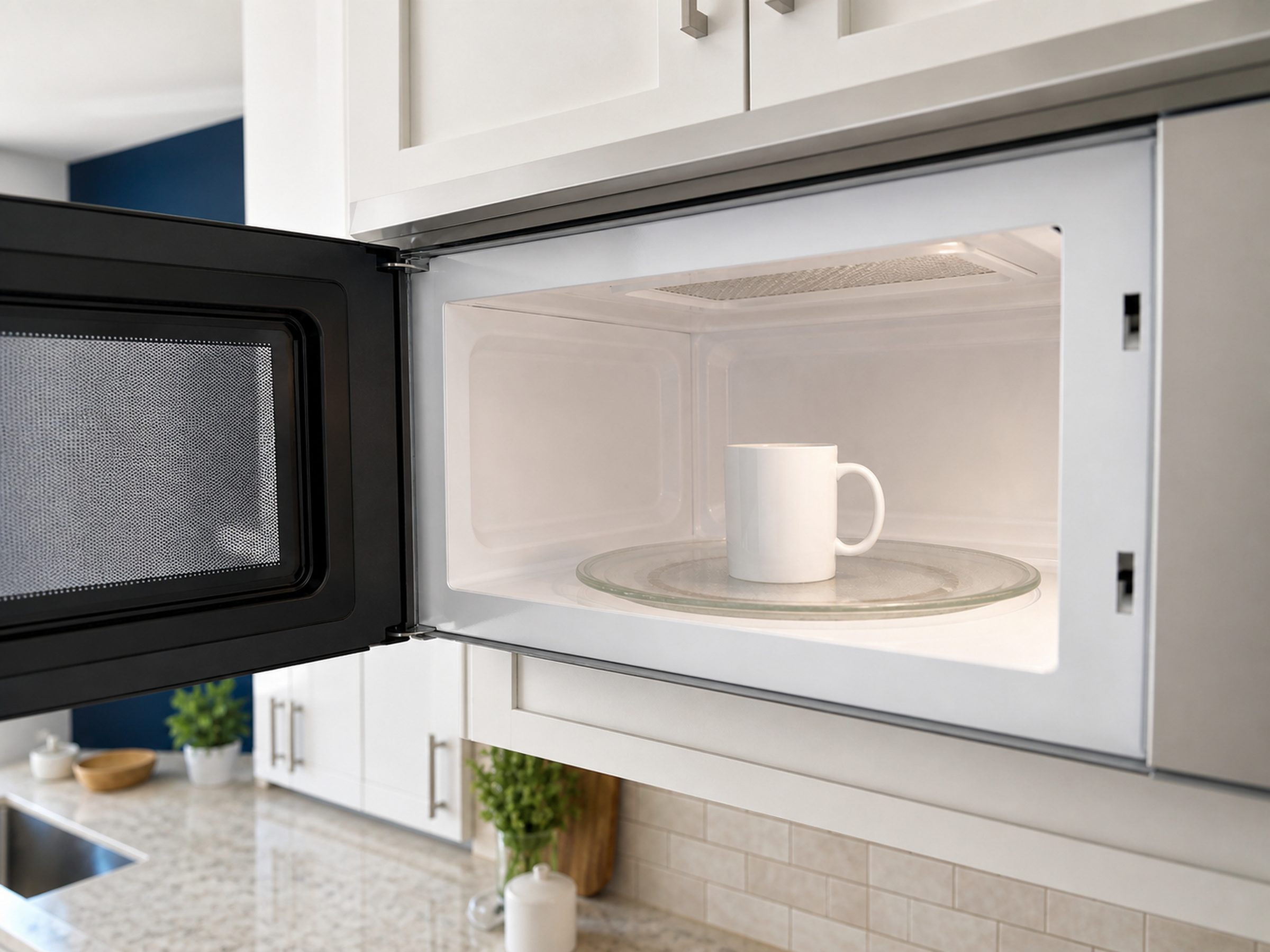
- “A microwave holds a lethal charge in its capacitor after it is unplugged — this one is not a home repair”
- “E21 is Whirlpool's thermal sensor circuit reported open; F4 E1 is the cavity temperature sensor”
- “The one safe test is a cup of water and a clock”
Symptom
Whirlpool microwave runs but does not heat
A microwave that lights, turns and counts down while heating nothing has a high-voltage problem, and this is the one appliance on this site where we would rather you did not open anything at all. Whirlpool's own code table for these is deep — 226 code pages across its microwave branch — and several of the codes point at exactly this.
- From $89 diagnostic, credited to the repair
- 59 cities and neighborhoods covered
- OEM parts available on order
- In writing the price, before anything is opened
Five ordinary causes
What this usually turns out to be
Cheapest and commonest first, which is also the order we check them in. They sit hundreds of dollars apart, and only the unit settles which one is yours.
-
The magnetron
The part that makes the microwave energy. When it fails, everything else keeps working perfectly and nothing gets hot.
Microwave repair from $165 -
The high-voltage diode or capacitor
Common failures and often accompanied by a buzz or a smell. Only ever handled with the charge safely bled off.
Microwave repair from $165 -
A door interlock switch
The microwave will not produce energy unless it is certain the door is closed. A worn latch can leave a machine that runs and does not cook.
Microwave repair from $165 -
A temperature sensor circuit
Whirlpool codes E21 as the thermal sensor circuit reported open to the control board, and F4 E1 as the cavity temperature thermistor.
Microwave repair from $165 -
The control board
F6 E0 and F9 are both Whirlpool's report that the oven could not execute the function, pointing at the appliance control board or its wiring.
Appliance control board repair from $265
In five minutes
Before you call anybody
None of it needs tools, and all of it makes the visit shorter.
-
01
Run the cup-of-water test
One minute, full power, then feel it. It is objective, it is safe, and it tells us more than a description of the food.
-
02
Listen for a change in the hum
A microwave with a failed high-voltage part often sounds different — louder, or with a buzz that pulses. Say so if you hear it.
-
03
Note any code exactly
E21, F4 E1, F6 E0 and F9 are all real entries in Whirlpool's own table and each points somewhere different.
-
04
Check whether the fan and light still work
On an over-the-range unit that decides whether you still have ventilation while you wait for the repair.
How it shows up
What people describe when they call
A shortcut
Narrow it down before anybody arrives
A description of the behaviour leaves a few possible causes. A code names the subsystem before anybody opens anything, which is why it is worth photographing before it clears.
If there is no code at all
The data plate is inside the cabinet, upper left wall or behind the grille. All models
In more detail
About Whirlpool microwave runs but does not heat
One safe test, and one thing not to do
Put a cup of cold water in the microwave and run it on full power for one minute, then feel the water. Warm means the magnetron is producing something and the problem is more subtle than it looks. Stone cold means it is producing nothing. That is the whole of what can be tested safely from outside the case. Do not open the cabinet. The capacitor inside a microwave stores enough energy to injure or kill someone long after it has been unplugged, and there is nothing in there that a homeowner should be reaching for.
What it usually means, by the kind of machine
Whirlpool sells one appliance in several forms — a top-loader with an agitator and one without, a front-loader, a stacked pair, a laundry tower and an all-in-one; a vented dryer, a ventless one and a heat pump — and the same behavior points at different things on each of them. A top-load washer has no drain pump filter to open and a front-loader does, which is the whole first hour of the same complaint on two machines.
- Over-the-range — Doubles as the hood over the range, so a microwave that will not heat may still be needed for ventilation. Say if the fan and light still work.
- Built-in — Set into a cabinet or stacked with a wall oven. Whirlpool publishes a separate no-power page for these, and access is the difference on the visit rather than the diagnosis.
- Countertop — The one case where the value of the repair has to be weighed honestly against the price of the appliance, and we will say so rather than quote around it.
Why this page is shorter on advice than the others
Every other symptom on this site has something an owner can usefully check. This one really does not, beyond the water test, and we would rather say that than pad the page out. The high-voltage section of a microwave is genuinely dangerous to anyone without the equipment to discharge it, and the internet is full of advice that skips over that. Whirlpool's own pages for these codes stop at a power reset and then send you to a technician, which is the same conclusion for the same reason.
What the visit settles
We measure the high-voltage circuit properly, read whatever the control has stored and check the door interlocks, and then tell you plainly whether the repair is worth doing. On a built-in or an over-the-range unit that matches the rest of the kitchen, it usually is. On a countertop machine it often is not, and you will get that answer from us rather than a quote that quietly assumes otherwise.
This article is based on:
- Official manufacturer documentation
- Internal repair procedures
- Technician repair history
- Company quality standards
Before you book
Questions about Whirlpool microwave runs but does not heat
Is it safe to keep using it in the meantime?
If it heats nothing, there is little point, and if there is any smell of burning or any arcing inside the cavity, stop using it now and unplug it. A microwave that sparks is not something to finish the week with.
It heats sometimes and not others.
Intermittent heating usually points at the high-voltage components starting to fail rather than at anything to do with the food or the settings, and it generally becomes permanent quickly. Worth booking while you can still choose the day.
Where we do it
Across Miami-Dade, Broward, and Palm Beach
Same terms everywhere we go: an on-site diagnostic first, the price agreed in writing, and the exact figure confirmed once we have seen the unit.
Neighborhoods people ask for by name