- “LF, Lo FL and F8 E1 are the same condition, spelled three ways”
- “HC and F3 E2 mean the hot and cold hoses are on the wrong way around, which happens on every move”
- “The problem is on the wall more often than in the washer”
Symptom
Whirlpool washer will not fill, or fills too slowly
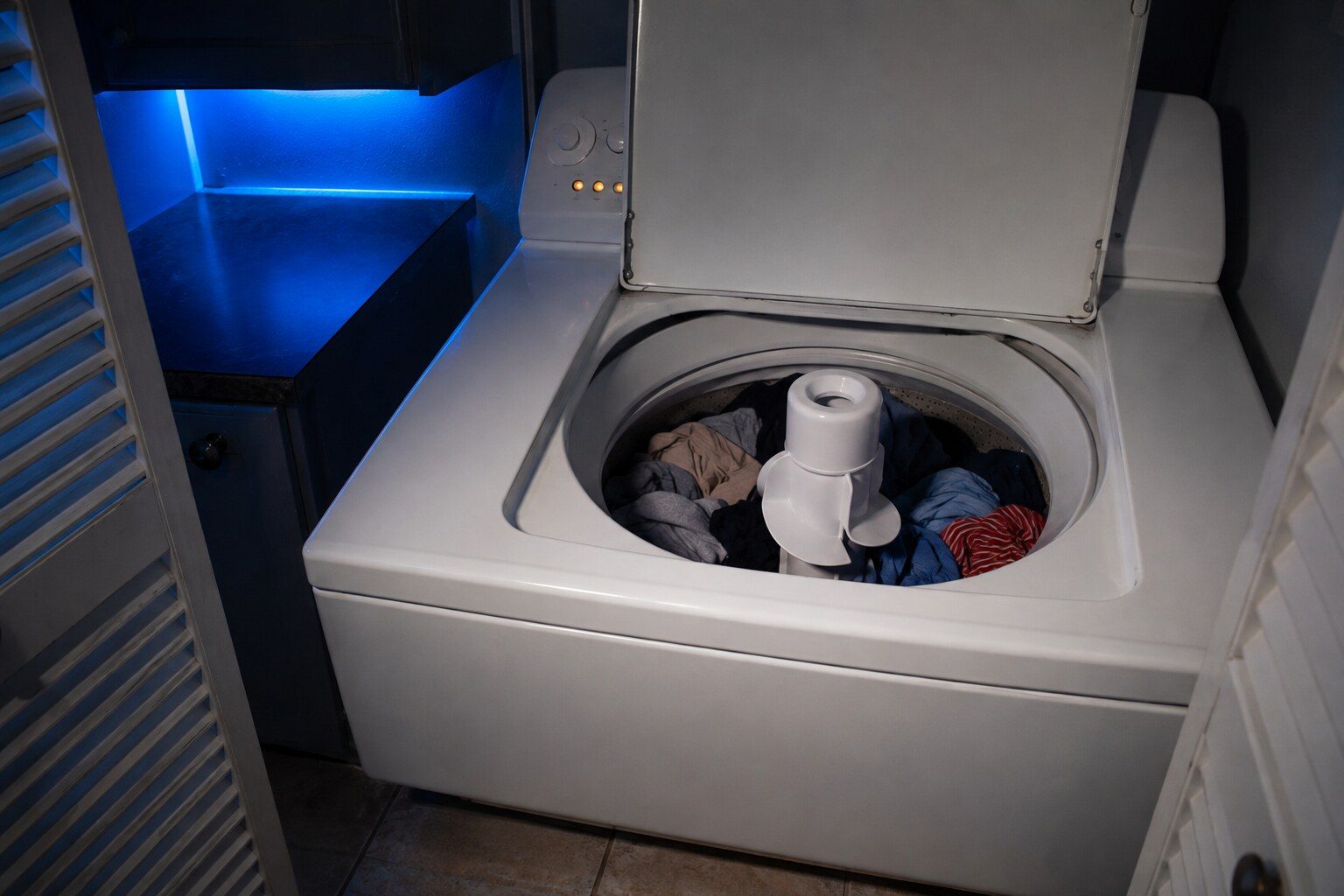
Whirlpool washers watch the water arriving and stop when it does not. The machine gives this one three different labels depending on how old it is and which control it has — LF, Lo FL and F8 E1 are one finding under three names, and the maker's own wording is that the washer is taking too long to fill or is not detecting the right amount of water coming in.
- From $89 diagnostic, credited to the repair
- 59 cities and neighborhoods covered
- OEM parts available on order
- In writing the price, before anything is opened
Five ordinary causes
What this usually turns out to be
Cheapest and commonest first, which is also the order we check them in. They sit hundreds of dollars apart, and only the unit settles which one is yours.
-
A supply valve that is not fully open
The commonest cause and the cheapest. Nothing inside the machine has changed; the water is being throttled before it arrives.
Diagnostic visit from $89 -
Blocked inlet screens
Fine mesh at the point where the hoses meet the washer. They catch grit and scale, and they silt up quietly over years.
Appliance maintenance from $119 -
Hoses connected the wrong way around
Whirlpool reports this as HC, or as F3 E2 on machines that show numbered codes. It shows up the week after a move, every time.
Appliance installation from $139 -
The water inlet valve
The valve on the machine that opens to let water in. When it weakens, the fill gets slower for months before the machine finally stops.
Diagnostic visit from $89 -
Water level sensing
F3 E1 is a washer that cannot read its own level. It may fill and fill because it never sees the water it already has.
Appliance control board repair from $265
In five minutes
Before you call anybody
None of it needs tools, and all of it makes the visit shorter.
-
01
Open both valves fully and listen
Water arriving at the machine makes a sound you can hear with the lid open. Silence at the start of a cycle is the finding.
-
02
Test hot and cold separately
Run a hot wash and then a cold one. A machine that fills on one and not the other has told you which side to look at.
-
03
Feel the hoses during a fill
A hose that stays limp is not carrying water. It is a crude test and it works.
-
04
Check for a pressure problem in the building
In a condo where the neighbors are complaining too, the washer is the messenger and not the problem.
How it shows up
What people describe when they call
A shortcut
Narrow it down before anybody arrives
A description of the behaviour leaves a few possible causes. A code names the subsystem before anybody opens anything, which is why it is worth photographing before it clears.
If there is no code at all
The data plate is inside the cabinet, upper left wall or behind the grille. All models
In more detail
About Whirlpool washer will not fill, or fills too slowly
Check the wall before you blame the machine
Turn both supply valves off and on again fully, and look at the hoses while you are there. The washer is downstream of everything: a valve that was never opened all the way after an appliance was moved, a screen at the hose end packed with grit, a hose kinked where the machine was pushed back into a closet. If hot water reaches the kitchen sink and the washer still reports a fill problem on hot only, the hose or the valve on that side is the suspect. If HC or F3 E2 is showing, the two hoses have been swapped and the fix is to swap them back.
What it usually means, by the kind of machine
Whirlpool sells one appliance in several forms — a top-loader with an agitator and one without, a front-loader, a stacked pair, a laundry tower and an all-in-one; a vented dryer, a ventless one and a heat pump — and the same behavior points at different things on each of them. A top-load washer has no drain pump filter to open and a front-loader does, which is the whole first hour of the same complaint on two machines.
- Top-load HE — Fills to a sensed weight rather than to a fixed level, so a low water level can look deliberate. Whirlpool has a separate page for a low water level because so many people report it as a problem when it is not.
- Front load — Fills very little by design and reports a slow fill as F8 E1 or, on older controls, F20 and FH. A machine that shows F20 within a minute of starting is reporting no water rather than slow water.
- Compact front load — Whirlpool documents a Water Tap is Closed message on these, which is as literal as a code gets, and it is right more often than not.
Three labels, one condition
This is the clearest example of why Whirlpool codes have to be read as a family rather than looked up one by one. LF is what a top-load HE machine shows. Lo FL is what a front-loader of a certain age shows. F8 E1 is what a current control shows. Whirlpool's own pages carry all three, and behind them is one measurement: the water is not arriving in the volume the cycle expected in the time it allowed. Somebody searching for their exact three characters finds three different pages and thinks they have three different problems.
Why we start outside the machine
A washer is the last thing on a long water path, and in this part of the world that path runs through valves that get closed for hurricane season, hoses that get kinked when a floor is retiled, and supply lines that carry more sediment than the manual assumes. Everything on the wall is free to check and takes minutes. The inlet valve inside the machine is a real part with a real cost, and it is worth proving before it is bought.
This article is based on:
- Official manufacturer documentation
- Internal repair procedures
- Technician repair history
- Company quality standards
Before you book
Questions about Whirlpool washer will not fill, or fills too slowly
It fills, but only a little.
On a high-efficiency machine that may be exactly right. These washers use a fraction of what older ones did and the load is rarely covered. Judge it by whether the laundry comes out clean, not by the water line.
It started right after the washer was moved.
Then look at the hoses first. A kink behind the machine and a pair of hoses swapped hot for cold are the two things that reliably happen during a move, and Whirlpool has a code for the second one.
Where we do it
Across Miami-Dade, Broward, and Palm Beach
Same terms everywhere we go: an on-site diagnostic first, the price agreed in writing, and the exact figure confirmed once we have seen the unit.
Neighborhoods people ask for by name