- “uL and oL are the machine telling you about the load, not about itself”
- “A top-load HE washer with no agitator balances by sensing weight, and one heavy item defeats it”
- “F7 E1 is a motor speed problem, and it is the point where the visit stops being free advice”
Symptom
Whirlpool washer will not spin
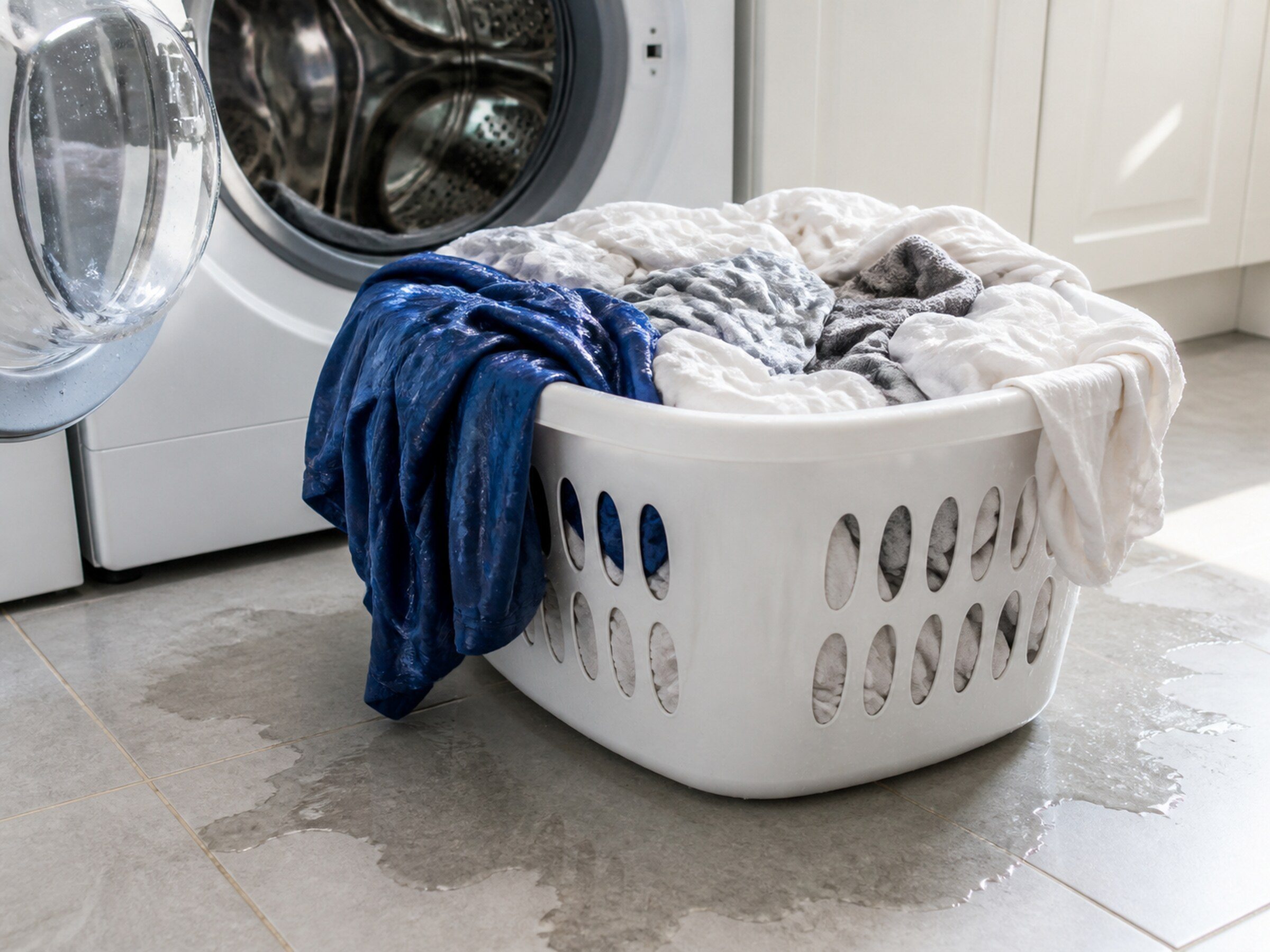
A load that comes out heavy and dripping has either not been spun or has been spun at a speed the machine chose for itself. Whirlpool machines lower the spin speed on their own when they cannot balance the drum, which is why a bath mat washed alone is the single commonest cause of this call, and the one that costs nothing.
- From $89 diagnostic, credited to the repair
- 59 cities and neighborhoods covered
- OEM parts available on order
- In writing the price, before anything is opened
Five ordinary causes
What this usually turns out to be
Cheapest and commonest first, which is also the order we check them in. They sit hundreds of dollars apart, and only the unit settles which one is yours.
-
The load, and only the load
One towel, one mat, one comforter. Whirlpool reports it as uL, oL or F0 E5 and every one of those is a message about what is in the drum.
Diagnostic visit from $89 -
A machine that is not level
On a tiled floor over a concrete slab, a foot that has backed out by a half-turn is enough. Leveling is part of every visit we make to a washer.
Appliance installation from $139 -
The lid lock or door lock
A Whirlpool washer will not spin until it can confirm the lid is secured. LdL and F5 E3 are that circuit, and the switch is a small part.
Washer lid lock and lid switch repair from $139 -
The drive system
Belt, coupler or the rotor on a direct-drive machine. The drum turns freely by hand and does nothing under power.
Washer motor and drive repair from $265 -
Motor speed sensing
F7 E1 is Whirlpool's motor speed error — the motor cannot reach the speed the cycle asked for. This is a real repair, not a loading habit.
Washer motor and drive repair from $265
In five minutes
Before you call anybody
None of it needs tools, and all of it makes the visit shorter.
-
01
Run a rinse and spin with the drum empty
An empty drum that spins up cleanly clears the machine and points the whole problem at loading. It takes twelve minutes and settles it.
-
02
Push the top corners of the cabinet
If it rocks, it is not level, and a machine that rocks will refuse to spin long before it damages itself.
-
03
Watch the lid lock
The latch should click and the indicator should stop flashing. A lock that keeps trying is a lock that has been found and reported.
-
04
Note the code and the moment it appears
A code at the start of the spin and a code twenty minutes in are different findings, and it is worth telling us which.
How it shows up
What people describe when they call
A shortcut
Narrow it down before anybody arrives
A description of the behaviour leaves a few possible causes. A code names the subsystem before anybody opens anything, which is why it is worth photographing before it clears.
If there is no code at all
The data plate is inside the cabinet, upper left wall or behind the grille. All models
In more detail
About Whirlpool washer will not spin
Redistribute before you diagnose
Open the lid and look at where the laundry is sitting. If it is all on one side, spread it around the drum by hand, close the lid and run a rinse and spin. Whirlpool's own wording for uL is that the load is out of balance and the machine could not correct it on its own, and it stops to ask you to do it by hand. Wash one heavy item with two or three light ones rather than on its own. If the drum spins cleanly after that, nothing is broken and nothing needs buying. If it will not spin even empty, stop and book it.
What it usually means, by the kind of machine
Whirlpool sells one appliance in several forms — a top-loader with an agitator and one without, a front-loader, a stacked pair, a laundry tower and an all-in-one; a vented dryer, a ventless one and a heat pump — and the same behavior points at different things on each of them. A top-load washer has no drain pump filter to open and a front-loader does, which is the whole first hour of the same complaint on two machines.
- Top-load HE — No agitator, an impeller plate in the base, and a machine that decides its own spin speed from what it senses. One rug, one comforter or one pair of jeans on its own is what it cannot handle.
- Front load — Heavier drum, higher spin speed, and a machine that will refuse to spin at all rather than walk across the floor. Check that the shipping bolts came out if this started the week it was installed.
- Laundry center — The washer half sits under a dryer and cannot be leveled by feel from the front. On these, an out-of-balance report often turns out to be leveling rather than the load.
The machine is not guessing about the load
A Whirlpool top-load HE washer has no agitator post. It senses the weight of what you put in, fills to suit it and chooses a spin speed from what it can feel. That design uses far less water than the machines it replaced and it has one honest weakness: a single dense item soaks up water on one side, and the drum cannot be balanced at speed. The machine's response is not a failure. It slows down, tries again, slows down again, and eventually stops and tells you. A load that comes out wetter than it should on a machine that has been fine for years is nearly always this.
Where it stops being the laundry
The line is easy to draw. Empty the drum and ask for a spin. A machine that spins up empty and refuses with two towels in it is a loading story. A machine that will not spin empty has something in the drive, the lock circuit or the motor control, and the code will usually say which. That is where the visit earns its money, and where being the most ordinary badge in the state helps: these parts are on the van rather than on order.
This article is based on:
- Official manufacturer documentation
- Internal repair procedures
- Technician repair history
- Company quality standards
Before you book
Questions about Whirlpool washer will not spin
It spins, but the clothes are still very wet.
That is a low spin speed rather than no spin, and it is usually either the cycle you chose or the machine backing itself off because of balance. Try the same load on a rinse and spin at the highest speed the machine offers and see whether it comes out different.
It bangs badly during the spin.
Stop using it on high spin until somebody has looked. Banging is either balance or worn suspension, and a machine allowed to slam on every cycle takes the outer tub and the bearing with it.
Where we do it
Across Miami-Dade, Broward, and Palm Beach
Same terms everywhere we go: an on-site diagnostic first, the price agreed in writing, and the exact figure confirmed once we have seen the unit.
Neighborhoods people ask for by name