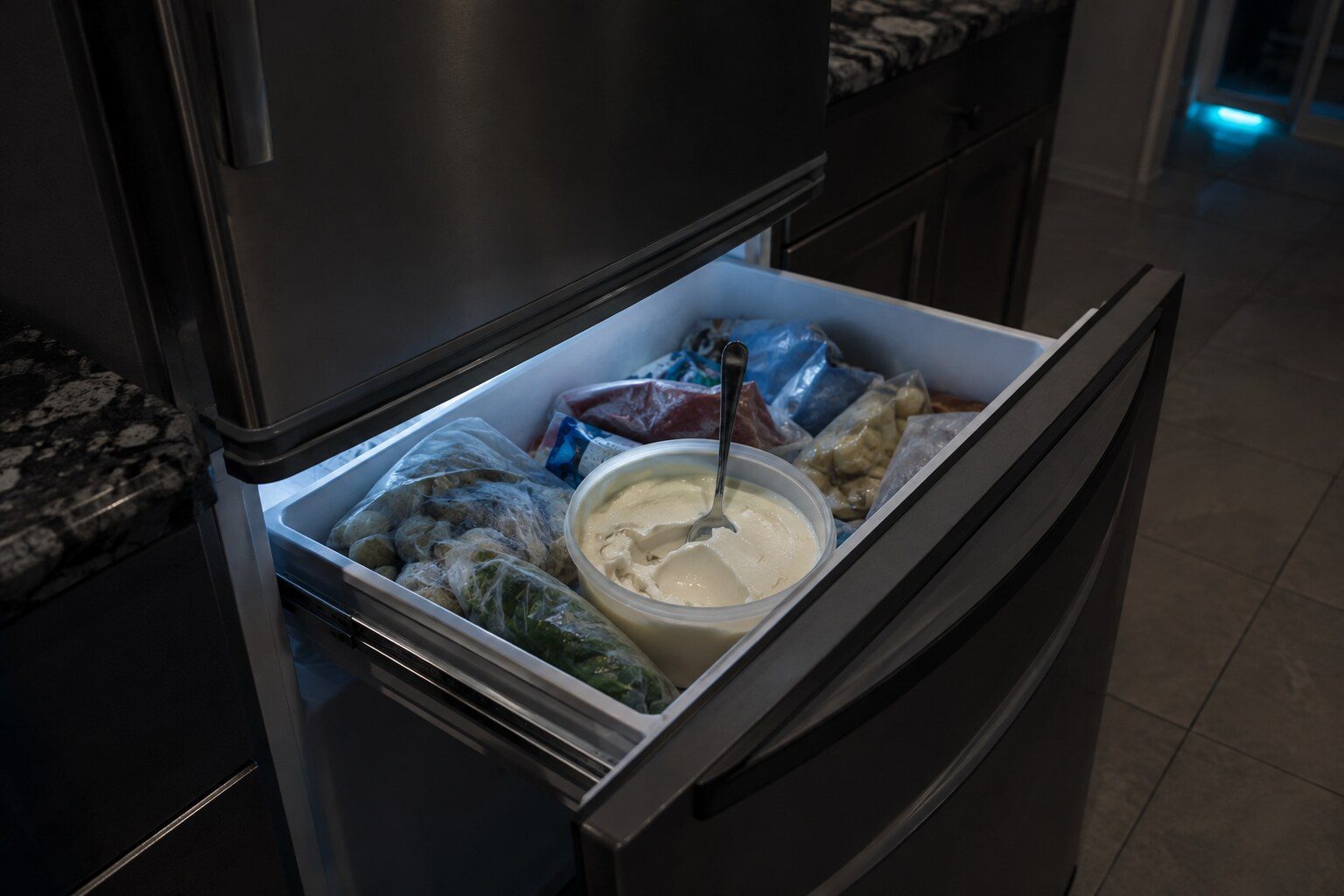
- “Zero code pages in Whirlpool's entire upright freezer branch — this one is all measurement”
- “Ice cream softens several degrees before anything else does; it is an early warning”
- “A compartment loaded up to its rear vents starves itself of the air it needs”
Symptom
Whirlpool freezer is not keeping things frozen
Whirlpool's upright freezer branch publishes 63 pages and not a single error code. There is nothing to look up, and the compartment cannot tell you what is wrong. What it does tell you is a temperature, and the difference between 5 degrees and 20 degrees decides whether this is tonight's problem or next week's appointment.
- From $89 diagnostic, credited to the repair
- 59 cities and neighborhoods covered
- OEM parts available on order
- In writing the price, before anything is opened
Six ordinary causes
What this usually turns out to be
Cheapest and commonest first, which is also the order we check them in. They sit hundreds of dollars apart, and only the unit settles which one is yours.
-
The room it stands in
A garage in South Florida in August is beyond what many freezers are rated to work in. The appliance is not broken; it is losing a fight.
Diagnostic visit from $89 -
Airflow blocked from inside
A compartment packed to the walls stops the cold circulating. Costs nothing to check and it happens constantly after a big shop.
Diagnostic visit from $89 -
A door or lid that no longer seals
Even frost across everything and a compartment that never quite gets there. The paper test settles it.
Refrigerator door seal replacement from $135 -
The condenser coil
Dust in a garage, corrosion near the coast. A freezer that cannot shed heat cannot make cold.
Condenser cleaning service from $115 -
The defrost circuit
Ice building on the evaporator until air cannot pass. Slow, invisible from the front, and it takes weeks.
Defrost system repair from $165 -
The sealed system
Uncommon, and the last thing looked at. Pressures get read before it appears in any price.
Upright and chest freezer repair from $145
In five minutes
Before you call anybody
None of it needs tools, and all of it makes the visit shorter.
-
01
Measure, do not judge by hand
A thermometer between packages, read after several hours. Everything else on this page depends on that number.
-
02
Check the ice cream first
It is the most sensitive thing in the compartment and it goes soft several degrees before the meat does.
-
03
Look at the door closing
It should seat itself. A garage freezer with boxes stacked against it is a real and frequent cause.
-
04
Feel the room temperature
If the space is above 90 degrees, say so when you book. It changes what we expect to find and what we will recommend.
How it shows up
What people describe when they call

A shortcut
Narrow it down before anybody arrives
A description of the behaviour leaves a few possible causes. A code names the subsystem before anybody opens anything, which is why it is worth photographing before it clears.
If there is no code at all
The data plate is inside the cabinet, upper left wall or behind the grille. All models
In more detail
About Whirlpool freezer is not keeping things frozen
Put a thermometer in and give it time
Put a thermometer between the packages, not against the wall or on the floor of the compartment, and read it in the morning. Zero degrees is right. Ten degrees keeps meat indefinitely and leaves ice cream soft every time. At twenty degrees the clock is running and the contents should be moved. While you are there, check that the vents at the back are not buried under food and that the door closes fully on its own — a garage freezer with a heavy load leaning against the door is a common and completely free finding.
What it usually means, by the kind of machine
Whirlpool sells one appliance in several forms — a top-loader with an agitator and one without, a front-loader, a stacked pair, a laundry tower and an all-in-one; a vented dryer, a ventless one and a heat pump — and the same behavior points at different things on each of them. A top-load washer has no drain pump filter to open and a front-loader does, which is the whole first hour of the same complaint on two machines.
- Upright freezer — Stands alone, often in a garage or a utility room, and in this climate that room can reach 100 degrees. Many models are not rated for that ambient temperature at all.
- Chest freezer — Holds temperature far better when the door is opened because cold air does not fall out. A chest freezer drifting is usually the seal or the lid closing on something.
- Freezer compartment — Part of a refrigerator, sharing its evaporator and defrost circuit. Judge it alongside the fresh food side rather than on its own.
The garage freezer problem
An enormous number of households here keep a second freezer in the garage, and a garage in Broward or Miami-Dade in August spends the afternoon well above 100 degrees. Most freezers are rated to work within a stated ambient range, and many ordinary models are not rated anywhere near that. The result is a freezer that holds perfectly from December to April and drifts every summer, arrives for repair, and measures correctly on the bench. Where we find that, we will say so — the fix is a garage-rated appliance or a cooler location, not a repair.
Reading a freezer without a code table
Whirlpool gives us nothing to look up here, so the visit is a sequence of measurements: compartment temperature, the temperature difference across the coil, the airflow at the vents, the door seal, and the sealed system pressures if everything cheaper has been eliminated. That is more work than reading a code, and it is the honest way to do it on a make that publishes nothing for this appliance.
This article is based on:
- Official manufacturer documentation
- Internal repair procedures
- Technician repair history
- Company quality standards
Before you book
Questions about Whirlpool freezer is not keeping things frozen
How long do I have?
Below about 10 degrees the food is safe and there is time to book properly. Above 20 it is worth moving what matters into a cooler now. Whatever the reading, keep the door shut between now and the visit.
It has been fine for years and only struggles in summer.
That points at the room and at heat rejection rather than at the cooling system itself. The coil, the ambient temperature and the ventilation around the cabinet are the first three things we would look at.
Where we do it
Across Miami-Dade, Broward, and Palm Beach
Same terms everywhere we go: an on-site diagnostic first, the price agreed in writing, and the exact figure confirmed once we have seen the unit.
Neighborhoods people ask for by name